
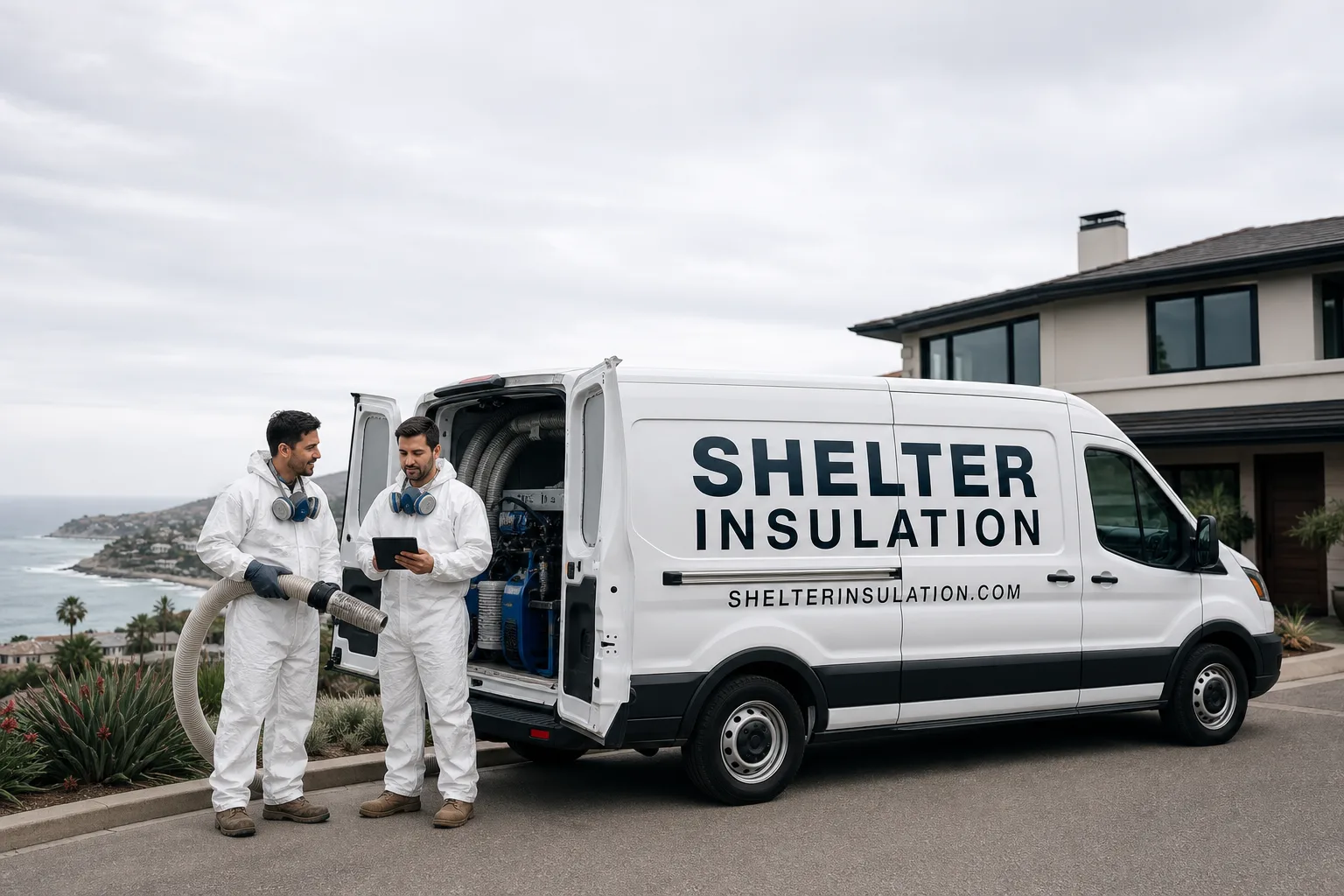
Fast, Reliable Spray Foam Insulation Across Portola Hills
Spray foam insulation in Portola Hills solves a problem most tract-home builders never accounted for: attics that step down over living areas, leaving knee walls and rafter bays that fiberglass batts simply can’t seal. In this part of the Saddleback Valley foothills, the marine layer rolls in most mornings and burns off by noon, so homes swing between cool, damp air and intense afternoon radiant heat. That’s a demanding thermal cycle. Shelter Insulation has worked in Portola Hills long enough to know exactly where these homes leak, and our crews get to jobs in 92610 quickly when you call (855) 341-3373.
Why Shelter Insulation Is Portola Hills’s Preferred Spray Foam Insulation Company
Portola Hills homeowners tend to be research-minded. They’ve read about closed-cell versus open-cell foam, they know R-value isn’t the whole story, and they want straight answers. That’s the conversation Alan Brecker built Shelter Insulation around. We carry eight manufacturer lines, including Demilec and Icynene for spray foam, because no single product fits every hillside home here. Walk into a 1990s carriage-house-style place off Glenn Ranch Road and the attic geometry is completely different from a 2000s townhome near the Whiting Ranch side. One material, one method won’t do both properly.
Our reputation in Portola Hills comes from diagnosing the actual problem before recommending a product. We check the knee walls above garages first, because in this community they’re almost never insulated from the builder. We look at the cantilevered floor cavities where a stepped roof creates a hidden thermal bypass. Homeowners call us after years of drafty bedrooms and stubborn upstairs heat, and the fix usually isn’t more insulation in the flat attic; it’s sealing the transitions nobody sealed originally.
Shelter Insulation’s crews work across all three installation methods, attic insulation, Spray Foam Insulation, and blown-in, as one team. That matters when a Portola Hills home needs spray foam on the sloped rafter bays and blown-in or batts in the flat sections. You’re not coordinating two contractors and two warranty conversations. Alan’s approach from the start has been to carry Owens Corning, Johns Manville, Knauf, Rockwool, CertainTeed, Icynene, Demilec, and GreenFiber so the material follows the diagnosis, not the other way around.
Garage Spray Foam Insulation in Portola Hills
Garage Spray Foam Insulation in Portola Hills is one of the highest-impact upgrades we do, because so many homes here sit above a garage with a bedroom or bonus room directly on top. The original builders left the garage ceiling and knee walls bare or stuffed with thin R-11 batts that have sagged over 30 years. In the Saddleback Valley, the garage side of those walls catches afternoon sun while the living space above cools down overnight. The result is a thermal break that never works. Spray foam, applied to the garage ceiling deck and the knee wall transitions, turns that void into a continuous air and thermal barrier.
What the Job Involves
We air-seal the top plates where the garage framing meets the living floor above, then apply foam to the ceiling cavities and any vertical knee-wall sheathing. In hillside homes where part of the garage is built into the slope, we address the soil-side walls too, which pull moisture and cold from the earth. A typical garage ceiling and knee wall spray foam job in Portola Hills runs $1,200 to $2,800 depending on square footage and access.
Signs You Need It
Cold floors in the room above the garage are the tell. If you can stand in the garage on a summer afternoon and feel the heat radiating down from the ceiling, that heat is moving into your living space. Homeowners often mistake it for poor HVAC ducting, but sealing the garage boundary usually cuts the complaint in half before any equipment changes.
Closed Cell Spray Foam Insulation in Portola Hills
Closed Cell Spray Foam Insulation in Portola Hills is our default recommendation for sloped rafter bays and knee walls, where open-cell doesn’t have the rigidity or moisture resistance the foothill climate demands. Closed-cell foam adds structural strength to the roof assembly, which matters on hillside lots where wind sheer off the Santa Ana Mountains hits the upper walls and roof. It’s also an air barrier and vapor retarder in one, and that matters in 92610 because the marine layer delivers damp mornings that open-cell can absorb.
When to Choose It
Use closed-cell for kneewalls above garages, cantilevered floor cavities, and any sloped ceiling where you’re only getting two to four inches of depth. At R-6.5 to R-7 per inch, it packs the most thermal resistance into a tight space, which is exactly the condition most Portola Hills stepped attics create. A two-inch closed-cell lift in a limited-clearance rafter bay does more than six inches of fiberglass stuffed badly.
Local Application Notes
We’ve seen closed-cell foam applied too thick in one pass on Portola Hills sloped bays blister when the attic is over 100°F during installation. That’s an applicator error, not a product flaw, and one reason we watch substrate temperature carefully on summer jobs here. A homeowner recently asked why we won’t just fog the whole attic in one go; the answer is chemistry. Closed-cell needs staged lifts on hot days.
Trusted Brands We Service in Portola Hills
We carry Demilec and Icynene spray foam lines because both have track records in high-performance building envelopes, and because Portola Hills homeowners ask for them by name. Demilec’s closed-cell foam holds up in the brutal attic heat we get from July through September. Icynene’s open-cell is a better fit for flat ceilings where you want air sealing but not added rigidity. We also stock GreenFiber and Owens Corning products for the parts of a Portola Hills job that benefit from blown-in or batt materials, so you’re never forced into a single-material solution. Local stock means we don’t wait on supply chains when a job in 92610 needs a specific product on short notice.
Common Spray Foam Insulation Problems We See in Portola Hills Homes
- Bare knee walls above garages: In hillside tract homes, the attic knee wall above the garage was rarely insulated by the original builder. Heat pours through it in summer, and cold air sinks through it on foothill nights. We air-seal and foam these before touching anything else.
- Unsealed top plates in stepped attics: Where the roofline steps down over a living area, the framing transition is full of gaps. Spray foam over those unsealed plates traps moisture against the wood, and we’ve found rot that went unnoticed until ceiling stains appeared. Sealing before foaming is non-negotiable.
- Closed-cell blistered from single thick passes: On sloped rafter bays, installers who rush a job and apply closed-cell too thick in one lift see the foam overheat and blister, especially when attic temperatures exceed 100°F. It’s a classic Portola Hills summer failure mode. We stage the lifts.
- Foam that didn’t fully adhere to irregular sheathing: In knee walls and cantilevered floors where the sheathing has gaps or nails proud, foam that doesn’t bond leaves hidden air channels. The thermal break looks fine from the living space but fails where it matters. We prep and inspect every surface before spraying.
Pricing for Spray Foam Insulation in Portola Hills, CA
Spray foam pricing in Portola Hills reflects the irregular geometry of hillside construction. A straightforward garage ceiling foam job runs $1,200 to $2,800. Closed-cell spray foam on sloped rafter bays and knee walls typically lands between $3,100 and $6,400 depending on the square footage of sloped surface and how many transitions need air sealing. A full attic encapsulation, including top plate sealing, rafter bays, and the flat ceiling, can run $7,000 to $12,000 on a larger 1990s tract home. Open-cell is cheaper per board foot but gets consumed fast on stepped attics with lots of surface area. Call (855) 341-3373 for a free on-site estimate; we measure, inspect the knee walls, and give you a written number before any work begins.
We Also Serve Cities Near Portola Hills
Shelter Insulation works throughout the Saddleback Valley and the surrounding foothill communities. Beyond Spray Foam Insulation in Portola Hills, we serve Foothill Ranch, Lake Forest, Mission Viejo, and Trabuco Canyon. If you’re in one of those areas and considering spray foam, the same crew and the same material expertise applies.
Serving Portola Hills, CA — Our Local Coverage Area
We’re based in the Portola Hills area and know this community well. Use the map below to see our service coverage — if you’re nearby, we can almost certainly help.
FAQs About Spray Foam Insulation in Portola Hills
The knee walls above garages in Portola Hills hillside tract homes were almost never insulated when the homes were built, so they act as a direct thermal short between the garage and the living space above. Spray foam is the only material that conforms to the irregular sheathing and framing in those cavities, filling every channel and sealing the transition. In the Saddleback Valley climate, this is the difference between a bedroom that stays warm on a cool foothill night and one that feels like a drafty box. Call (855) 341-3373 to have us inspect your knee walls.
Closed-cell foam handles Portola Hills’ hot, dry summer days and cool marine-layer nights well, because it’s a rigid, closed structure that doesn’t absorb moisture and doesn’t lose R-value when temperatures swing. The key is applying it correctly; too thick a lift on a hot summer day can overheat and blister in a sloped rafter bay. We stage the lifts and monitor substrate temperature, which is standard practice for anyone who understands 92610’s specific climate. It’s not the product that fails; it’s sloppy application.
Spray foam can be applied around finished spaces without disturbing custom trim, wood doors, or built-in cabinetry, because our crews mask and protect all finished surfaces before spraying. The work happens in the cavities behind the drywall, in the attic, and inside the garage structures, not in the living space. For homes with carriage-house doors and detailed woodwork, that means the insulation upgrade is invisible from the finished side. The comfort improvement is what changes.
Closed-cell spray foam is the best approach for sloped attics with limited clearance, because it delivers R-6.5 to R-7 per inch and takes up far less depth than fiberglass or open-cell for the same thermal performance. In a stepped attic where the rafter bays over living areas have only a few inches of depth, two to three inches of closed-cell foam gives you a real thermal barrier without eating headroom. This is exactly the geometry we see throughout Portola Hills’ hillside tract homes. Call us for a measurement-based recommendation.
We use Icynene open-cell foam and Demilec closed-cell foam for Portola Hills spray foam work, and we also stock Owens Corning products for batt and blown-in applications where they’re the better fit. We carry both because the right product depends on the specific cavity and the thermal goal. A sloped rafter bay asking for air sealing and rigidity gets Demilec closed-cell; a flat ceiling that just needs air sealing and sound damping gets Icynene open-cell. Alan Brecker’s approach is always product-fit over brand loyalty.
Written by Alan Brecker, Owner at Shelter Insulation, serving Portola Hills and the Saddleback Valley.