
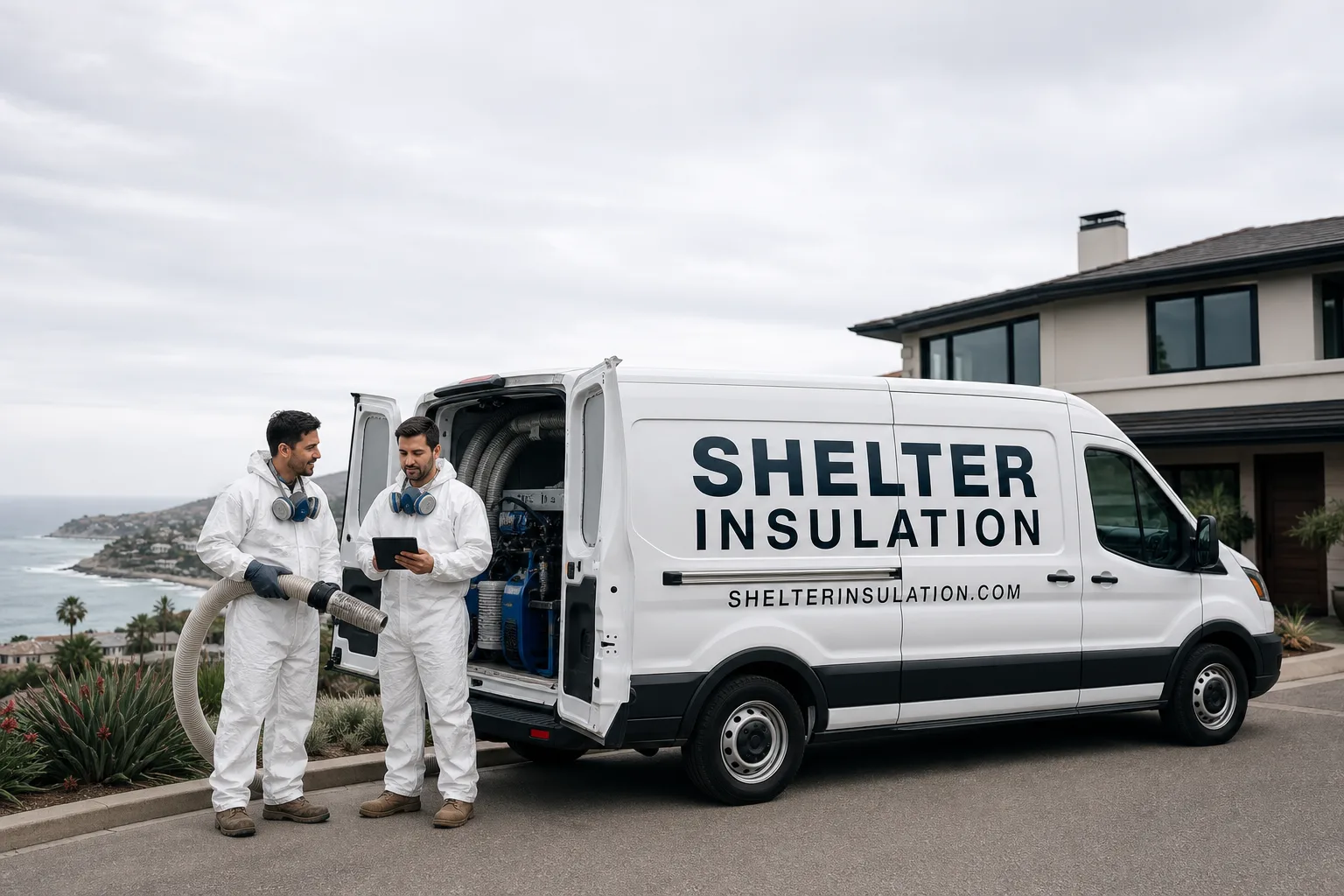
Fast, Reliable Spray Foam Insulation Across South San Jose Hills
Spray foam insulation in South San Jose Hills typically runs $2.50 to $6.50 per board foot installed, with a full rim joist project on a 1,500 sq ft home landing between $1,800 and $4,200. Most jobs are done in a single day, and we respond to service calls across the 91792 ZIP code within 24 to 48 hours. If you’re tired of running your AC nonstop through July and August while rooms still feel warm by 3 p.m., the problem usually isn’t your HVAC. It’s the air moving through your attic and walls. Call (855) 341-3373 for a free estimate and we’ll walk the house with you, explain what’s actually going on, and give you a straight answer.
Why Shelter Insulation Is South San Jose Hills’s Preferred Spray Foam Insulation Company
We’ve worked in enough South San Jose Hills homes to know what’s behind the drywall before we cut the first access hole. Most of these houses were built in the 1950s through 1970s, and the insulation choices made then were sized for a different climate reality. What we bring is product range: we’re authorized to install Icynene and Demilec spray foam, plus Owens Corning and GreenFiber for fiberglass and cellulose work. That means we’re not going to sell you the one product we stock. We’re going to match the material to the problem.
Alan Brecker started Shelter Insulation with a simple rule: carry the right materials for the building science, not the cheapest inventory model. That’s why we install open-cell and closed-cell foam, fiberglass, mineral wool, and cellulose. The choice depends on what your South San Jose Hills home actually needs, not what we happen to have on the truck. One crew handles everything, so you’re not coordinating an attic company, a wall company, and a rim joist company separately.
Spray Foam Wall Insulation in South San Jose Hills
Spray Foam Wall Insulation in South San Jose Hills is usually the difference between a house that holds temperature and one that fights you all summer. Many of these mid-century ranch and tract homes have original wall cavities that were never insulated at all, or have thin R-11 batts that have slumped and left voids at the top plates. When that happens, the stud bays become thermal bridges: outside heat radiates straight through the plaster, and every Santa Ana wind event pushes air through the cracks. Closed-cell foam in the wall cavities stops both. A typical wall retrofit on a 1,200 to 1,800 sq ft South San Jose Hills home runs $3,500 to $9,000 depending on cavity depth and access.
Closed-Cell for Stud Bay Retrofit
In older wood-frame homes near Valley Blvd and along the hillsides, closed-cell foam doubles as an air barrier and a vapor retarder. That matters here because the temperature swing between a 100°F afternoon and a 45°F winter night stresses wall assemblies. Foam locks the wall cavity tight and keeps conditioned air where you paid for it.
Open-Cell for Interior Walls
When the goal is sound control between rooms or around a home office, open-cell foam is the quieter choice. It also costs less per board foot, which makes sense when you’re insulating interior partitions that don’t face direct radiant heat.
Rim Joist Spray Foam in South San Jose Hills
Rim Joist Spray Foam in South San Jose Hills addresses the single most overlooked air leak in these homes: the band board where the floor framing meets the foundation. In houses built in the 1960s and 1970s, that rim joist was often left completely uninsulated, so outside air flows straight into the crawlspace or basement and then rises through the walls. Air-sealing and insulating the rim joist with closed-cell foam on a typical 1,500 sq ft home in South San Jose Hills runs $1,800 to $2,800, and returns savings on both summer cooling and winter heating.
Why the Rim Joist Fails Here
South San Jose Hills sees frequent Santa Ana events where dry wind pushes hard against the east and north walls. Any gap in the rim joist acts like a straw, pulling dust and outdoor air into the house. Foam expands to fill the entire band board, including the small gaps around plumbing and wiring penetrations that batt insulation can’t seal.
One Access Point, Full Coverage
Because most crawlspaces here are shallow and compacted, we typically insulate from the interior if there’s a basement, or via crawlspace access when the foundation is raised. Either way, the job is contained and usually done by early afternoon.
Trusted Brands We Service in South San Jose Hills
We carry Icynene because it’s one of the most widely specified open-cell and closed-cell foam lines in high-performance retrofits, and Demilec because its closed-cell formula holds up well in the temperature swings common to the San Gabriel Valley. For jobs where spray foam isn’t the right financial or structural fit, we keep Owens Corning batt and GreenFiber blown-in products in the lineup. Having those options means we won’t push foam into a situation that calls for cellulose. When a South San Jose Hills homeowner needs us to match an existing product or finish a partial job, we stock fast-moving materials locally and can turn around most requests within a week.
Common Spray Foam Insulation Problems We See in South San Jose Hills Homes
- Settled blown-in fiberglass. Decades of gravity and the dry inland air have compressed original loose-fill to 30-40% below its labeled R-value. We regularly find bare drywall at corners and top plates where the insulation has simply disappeared.
- Unsealed recessed can lights. The 1960s and 1970s tract homes along Valley Blvd and the hillsides often still have the original non-IC-rated cans, which leak conditioned air and create heat buildup. These need fire-rated covers and air-sealing before any foam can go in safely.
- Knob-and-tube wiring left in place. Some South San Jose Hills homes still have active or abandoned knob-and-tube circuits running through the attic. Spraying foam around live knob-and-tube is a code violation and a fire risk, so the wiring needs assessment first.
- Thin batts under low-pitch roofs. Original low-slope attics often hold only R-11 or less, and after years of re-roofs and additions, the coverage is uneven. Foam applied to the roof deck or the attic floor seams creates a continuous air barrier where the batts failed.
Pricing for Spray Foam Insulation in South San Jose Hills, CA
Open-cell spray foam in South San Jose Hills runs $1.10 to $2.50 per board foot; closed-cell runs $2.50 to $4.50 per board foot. Rim joist work on a typical 1,500 sq ft home lands between $1,800 and $2,800. Wall cavity retrofits run $3,500 to $9,000 depending on access and whether we’re drilling and filling or working from an open stud bay. Garage ceiling and roof deck projects are quoted by square footage and foam depth. The price differences come down to foam type, cavity depth, and how much prep work the job requires, especially when we’re working around older wiring and recessed cans. Call (855) 341-3373 and we’ll give you a written estimate with exact numbers, not a phone guess. Estimates are free.
We Also Serve Cities Near South San Jose Hills
Our crews cover Spray Foam Insulation in South San Jose Hills plus the surrounding communities of Valinda, Walnut, West Covina, and Rowland Heights. If your home sits right on the border of any of those cities, you’re still inside our regular service area and we’ll treat the job as local. For a deeper look at our full service area and what our Spray Foam Insulation team offers, visit the main service page.
Serving South San Jose Hills, CA — Our Local Coverage Area
We’re based in the South San Jose Hills area and know this community well. Use the map below to see our service coverage — if you’re nearby, we can almost certainly help.
FAQs About Spray Foam Insulation in South San Jose Hills
Yes. Closed-cell spray foam applied to the roof deck keeps the attic air from superheating, because the foam blocks radiant heat transfer before it ever enters the attic space. Homes here regularly see attic temps past 140°F by mid-afternoon, and open-cell on the attic floor won’t solve that. Closed-cell on the roofline will. Call (855) 341-3373 and we’ll measure your attic temps before recommending a deck.
No, and you shouldn’t let anyone do that. Foam needs direct contact with the substrate to adhere and form an air seal. Settled blown-in fiberglass has to be removed, the attic floor air-sealed, and then the right material reinstalled or foamed. We do this in South San Jose Hills attics all the time, and the removal is included in the quote we give you upfront.
Both need to be addressed before foam goes in. Recessed cans get fire-rated covers or are replaced with IC-rated fixtures, and any live knob-and-tube wiring is flagged for a licensed electrician to address first. We won’t foam around unmitigated heat sources, because that’s how attic fires start. It adds a step, but it’s the only safe way to do the job in these older South San Jose Hills homes.
Santa Ana winds push air hard against your exterior walls and find every gap in the rim joist, soffits, and wall top plates. Closed-cell foam is an air barrier, not just insulation, so it stops that wind-driven infiltration at the source. Once the rim joist and wall cavities are foamed, the drafts and the dust that come with Santa Ana events drop dramatically. Call (855) 341-3373 for an exact quote on your home.
Both, depending on the application. We use Demilec closed-cell for rim joists, rooflines, and anywhere moisture or structural rigidity matters. We use Icynene open-cell for interior walls and sound-buffering applications where closed-cell would be overkill. We carry both because South San Jose Hills homes have different needs in different parts of the house, and we’d rather fit the product to the job than force one foam into every cavity.
If your South San Jose Hills home is fighting the inland heat, losing cool air through settled insulation, or showing drafts every time the Santa Anas pick up, call (855) 341-3373. We’ll walk the attic and crawlspace with you, show you what we found, and give you a free estimate for spray foam that actually fits your house, no pressure.
Written by Alan Brecker, Owner at Shelter Insulation, serving South San Jose Hills and the surrounding San Gabriel Valley.