
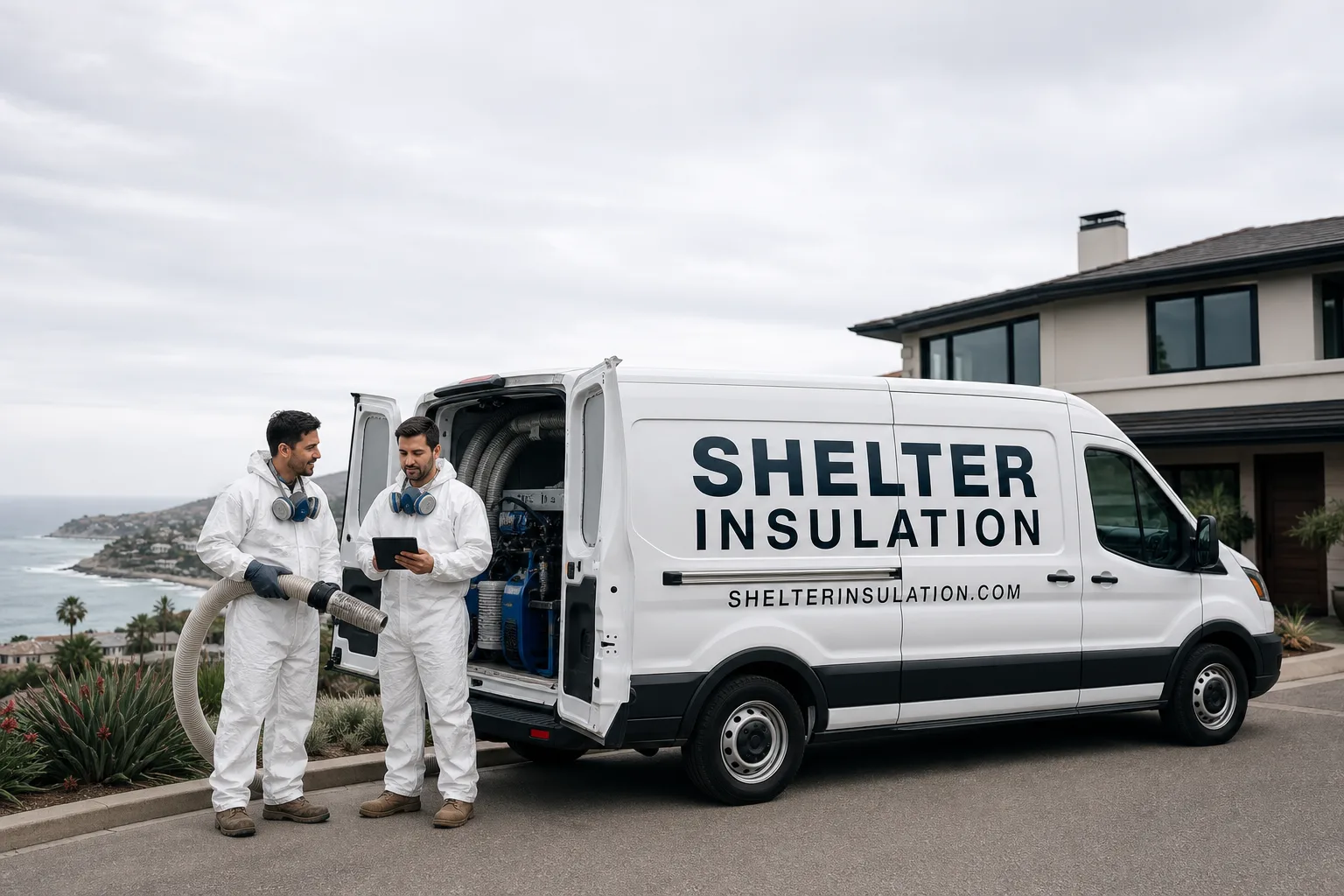
Fast, Reliable Spray Foam Insulation Across Whittier
Spray foam insulation in Whittier homes costs roughly $2,400 – $6,800 for a typical attic application, depending on whether you choose open-cell or closed-cell and how much square footage we’re sealing. Most jobs wrap up in one to two days. This isn’t a guess, it’s what we see across the 90601 to 90604 zip codes week after week.
We work in Whittier’s older housing stock constantly, and the homes here tell a specific story. A 1940s bungalow near uptown and a 1960s tract house east of Colima Road need different approaches because their attics behave differently in the summer heat that settles against the Puente Hills. Call us at (855) 341-3373 and we’ll walk you through what your roof cavity actually needs.
Why Shelter Insulation Is Whittier’s Preferred Spray Foam Insulation Company
Whittier homeowners rarely ask for the cheapest option. They ask what will actually stop the upstairs bedrooms from turning into ovens by 3 p.m. in August. That’s the conversation we’re built for. We carry eight manufacturer lines, which means when we recommend something, it’s because the material fits your rafter depth and wiring situation, not because it’s the only product sitting in our warehouse.
Our Spray Foam Insulation crews have spent enough time in Whittier attics to know what’s waiting up there before the ladder even goes up. Shallow 2×4 rafters. Foil-backed kraft from the Eisenhower administration. Knob-and-tube runs snaking through the bays. Alan Brecker started Shelter Insulation on the principle that insulation decisions should follow the house, not a sales script. That’s why Whittier homeowners get a straight answer about whether spray foam is even the right move, or whether a Rockwool top-up over the old wiring is the smarter call.
We hold manufacturer training credentials across the spray foam brands we install, including Icynene and Demilec, and we’re licensed and insured for residential work throughout southeast LA County. You won’t get a subcontracted crew from two cities over. You get the same Shelter Insulation team from the estimate through the final blower-door walkthrough.
Spray Foam Insulation Contractors in Whittier
Spray Foam Insulation Contractors in Whittier deal with a housing stock that was mostly built between the 1920s and the 1960s, and that changes the job completely. Closed-cell foam in a new-build attic is straightforward. Closed-cell foam in a 1950s tract home off Lambert Road with early drywall and minimal ventilation requires a different hand: we check clearance around every conductor, map the rafter depth, and decide whether low-expansion open-cell is the safer choice.
A full attic spray foam job in Whittier typically lands between $2,800 and $6,200 for closed-cell, with open-cell running closer to $2,400 – $4,900. The spread comes down to square footage, access, and whether we’re removing failed fiberglass batts first.
Low-Clearance Rafter Bays
Many uptown Whittier homes have 2×4 rafters, not 2x6s. High-expansion foam in those cavities bows plaster and drywall because there’s nowhere for the material to go. We spec low-expansion formulations in these attics and apply them in careful passes rather than one thick shot.
Wiring-Aware Application
Older Whittier neighborhoods, especially 90601 and 90602, still carry active knob-and-tube in the attic. Spray foam over that wiring without an inspection buries conductors and makes future electrical work miserable. We flag it, we work around it, and in some cases we recommend a different material entirely. That’s the honest call.
Spray Foam Attic Insulation in Whittier
Spray Foam Attic Insulation in Whittier is almost always about summer heat rejection, not winter warmth. The Puente Hills trap warm air against the north edge of the city, and the inland-facing east side bakes harder than the tree-canopied historic core around uptown. A sealed attic with closed-cell foam keeps that heat from pressing down through your ceilings all day.
The typical attic sealing job here runs $2,600 – $5,800 depending on the attic’s footprint and whether the existing insulation has to come out first. Most Whittier attics have thin fiberglass or nothing worth saving, so prep time is real.
Ventilation Before Application
Whittier’s older attics were rarely vented to modern standards. When we spray an unvented attic, we address the moisture path first. Sealing the roof deck without giving summer heat and humidity anywhere to go creates a different set of problems. We design the ventilation and the foam together, not one after the other.
Foil-Backed Kraft Removal
Homes built in the 1930s and 1940s off streets like Painter Avenue often have original foil-backed kraft facing stapled to the rafters. Spraying closed-cell directly onto that traps moisture against the paper and the foam peels in a few seasons. We pull it before we spray.
On one 1940s stucco bungalow off Hadley Street near uptown, our crew found original foil-backed kraft facing and shallow rafters laced with knob-and-tube wiring. We used Icynene low-expansion foam in the rafter bays rather than a straight open-blow, sealing the lid while keeping clearance off every old conductor. The homeowner’s attic heat rejection dropped noticeably within the same summer, and we flashed the penetrations we’d uncovered while we were up there.
Trusted Brands We Service in Whittier
We carry Icynene and Demilec because both make low-expansion formulations that behave well in tight, shallow Whittier rafter bays. Owens Corning and Johns Manville products show up when a house calls for batt and loose-fill work instead of or alongside spray foam. GreenFiber cellulose is our go-to for blow-in top-ups where old wiring makes foam impractical. We stock these materials for Whittier jobs specifically, so you’re not waiting on a regional warehouse transfer when the weather’s climbing and your upstairs is already warm by mid-morning.
Common Spray Foam Insulation Problems We See in Whittier Homes
- Foam over knob-and-tube wiring. In uptown attics especially, we regularly find spray foam applied by previous contractors directly over active knob-and-tube, leaving conductors buried and uninspectable. This is a code and safety problem, and it makes future electrical work genuinely harder.
- Bowed plaster from high-expansion foam. Whittier’s 2×4 rafter bays don’t tolerate high-expansion closed-cell. We follow behind other jobs where the ceiling now waves, and the fix usually involves removing foam, not patching plaster.
- Adhesion failures over foil-backed kraft. The 1920s – 1950s housing stock off Whittier Boulevard frequently still has the original reflective kraft. Foam sprayed over it loses grip within a few seasons and leaves moisture trapped behind it.
- Sealed attics with no ventilation plan. A hot, unvented Whittier attic that gets sealed without a moisture strategy holds heat and humidity against the roof deck. That shortens the roof’s life and makes the upstairs drier but hotter in summer.
Pricing for Spray Foam Insulation in Whittier, CA
Here’s what Whittier homeowners should expect:
- Open-cell spray foam: $2,400 – $4,900 for a typical 1,000 – 1,500 sq ft attic
- Closed-cell spray foam: $2,800 – $6,200 depending on roof deck coverage and prep
- Rim joist spray foam: $900 – $2,100 for crawlspace perimeter sealing in older Whittier homes
- Garage ceiling spray foam: $700 – $1,800 for detached garages common in postwar tracts
- Spray foam roof deck: $3,100 – $6,800 for full cathedral or vaulted ceiling applications
What moves the number in Whittier specifically: wiring density in the attic, whether foil-backed kraft needs removal, attic access, and whether we’re also correcting ventilation. We give a fixed, written quote before work starts. Call (855) 341-3373 for a free estimate, and we’ll send someone who knows the difference between an uptown bungalow attic and a Friendly Hills tract home attic.
We Also Serve Cities Near Whittier
Our crews regularly work in Whittier and the surrounding communities, including South Whittier, West Whittier-Los Nietos, East La Mirada, and Santa Fe Springs. The housing stock doesn’t change much at the city line, and neither does the way we approach it: wiring-aware, low-clearance, and honest about the material.
Serving Whittier, CA — Our Local Coverage Area
We’re based in the Whittier area and know this community well. Use the map below to see our service coverage — if you’re nearby, we can almost certainly help.
FAQs About Spray Foam Insulation in Whittier
No, and we won’t. Spraying over active knob-and-tube buries the conductors and creates a serious fire and inspection problem. We first bring in an electrician to assess, and we either work around the wiring with clearance passes or recommend an insulation material that doesn’t encapsulate it. Call (855) 341-3373 and we’ll walk you through what your specific attic needs.
If we use low-expansion foam and apply it in careful passes, no. Cracking happens when high-expansion foam fills a 2×4 rafter bay that has no room to accommodate the expansion. We match the foam formulation to your actual rafter depth, not the other way around.
Yes. Foam needs direct contact with the roof deck or framing to adhere properly. Foil-backed kraft prevents that bond and traps moisture against the paper, so we pull it and dispose of it before any spray application.
It can, but the case is different. Shaded uptown homes don’t get the same sun-driven heat load as the east side near the hills, so air-sealing often matters more than thermal resistance. In those attics, a thinner open-cell layer or a targeted sealing approach sometimes fits better than a full closed-cell job. We’ll tell you plainly which one your house actually calls for.
We assess the existing venting before spraying and build the moisture plan into the insulation design. Sealing an unvented attic without addressing the moisture path causes condensation against the roof deck. In most older Whittier homes, that means adding or upgrading intake and exhaust venting before the foam goes in. Call (855) 341-3373 for a free ventilation and insulation assessment.
Get Your Whittier Attic Sealed Right
Spray foam isn’t a one-size product, and Whittier’s older homes prove it every week. Shallow rafters, old wiring, foil-faced kraft, unvented cavities. If you want an honest assessment from a team that works this specific housing stock regularly, call (855) 341-3373. Estimates are free, and you won’t get pushed toward a product your attic shouldn’t have.
Written by Alan Brecker, Owner at Shelter Insulation, serving Whittier and southeast LA County.