
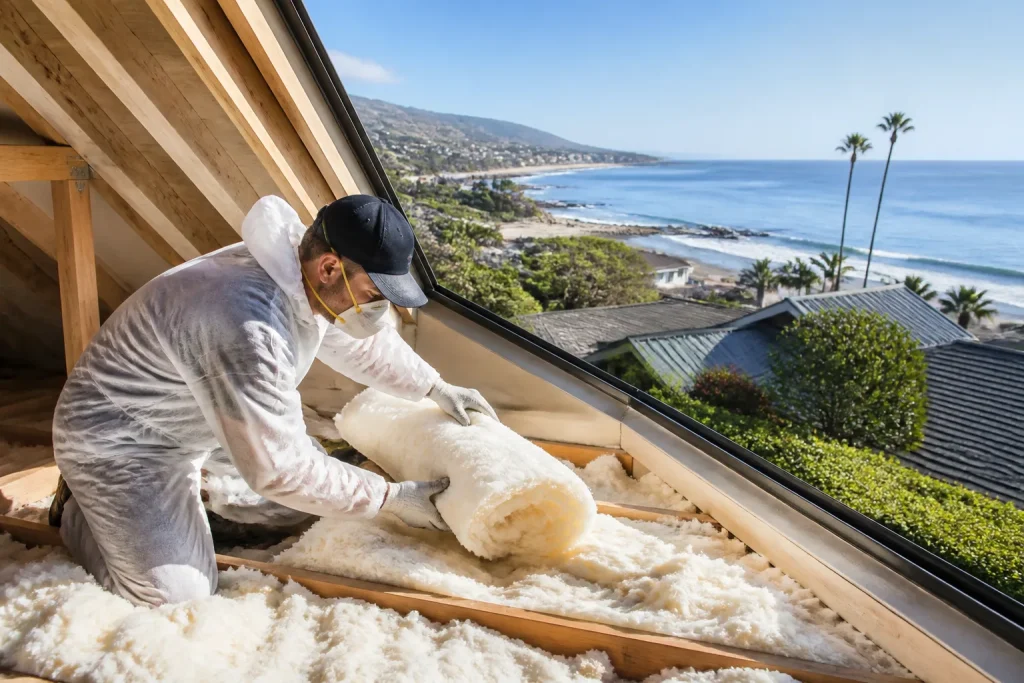
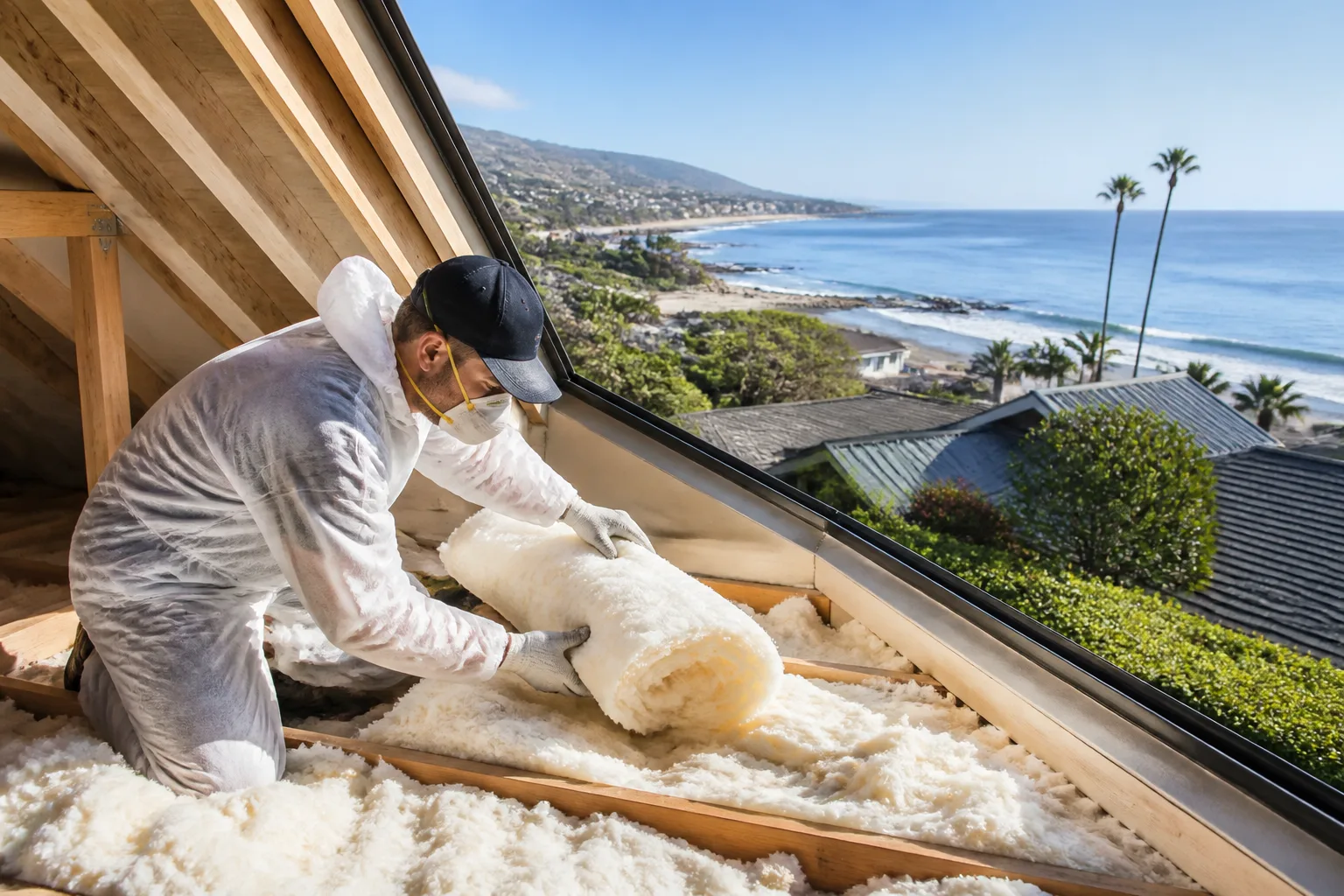
How to Choose the Right Insulation Company in Laguna Beach
The right insulation company in Laguna Beach will hold the proper California contractor license, carry workers’ compensation that covers attic and crawlspace work, and recommend different materials for different homes depending on what they find during the inspection. A contractor who quotes fiberglass batts for every attic without ever looking inside is selling labor, not performance. If you’d rather skip the research and talk to someone who carries eight brands and installs three different methods, call Shelter Insulation at (855) 341-3373.
Any contractor who quotes your attic without getting into it, asking about your HVAC layout, or mentioning air-sealing is selling installation labor, not insulation performance. We’ve pulled batts out of Laguna Beach attics that were installed over recessed lights, stuffed around bathroom fans, and laid directly on top of old knob-and-tube wiring. The homeowner paid for insulation. What they got was a fire hazard and a higher cooling bill.
Choosing the right company comes down to five things: licensing, inspection habits, material range, coastal experience, and how they handle the details most bids leave out. Here’s how to sort the thorough contractors from the volume installers.
Licensing and Insurance: What Laguna Beach Actually Requires
In California, insulation contractors need a C-2 license from the Contractors State License Board. That’s the floor. Anyone touching your attic without one is operating illegally, and their insurance won’t cover damage if something goes wrong.
Workers’ compensation is the other non-negotiable. Attic work in Laguna Beach is hot, cramped, and often involves navigating around older framing and mechanical systems. If a crew member gets injured on your property and the contractor doesn’t carry workers’ comp, you can be held liable. Ask to see the certificate. A legitimate company will have it ready before you ask twice.
You’ll also see contractors advertising various manufacturer certifications. These matter, but differently than most homeowners think. A certification from Owens Corning or CertainTeed means the contractor completed training on that brand’s installation requirements. It’s a useful signal. But a contractor certified in one product line is not the same as a contractor with access to multiple product lines. We’re authorized to install products from eight manufacturers because no single insulation type solves every Laguna Beach attic. A house in Mystic Hills with ocean-facing walls has different needs than a canyon home in Top of the World with full sun exposure.
One more thing: if a bid seems to avoid the licensing question entirely, that’s your answer. Move on.
The Five Diagnostic Questions That Reveal Everything
The estimate is a diagnostic appointment, not a sales call. Here are five questions to ask while the contractor is standing in your home, and what the answers tell you.
1. “What’s in my attic right now, and what condition is it in?”
A material-agnostic contractor will have climbed up and looked before quoting. If they haven’t been in the attic, they can’t know whether the existing insulation is compressed, rodent-damaged, moldy, or simply inadequate. Anyone quoting from the curb is guessing.
2. “Which material do you recommend for this specific attic, and why not the alternatives?”
This is the question that separates a materials expert from a product rep. If the answer is always spray foam, or always fiberglass, the contractor is telling you what they stock, not what your home needs. We carry Johns Manville and Knauf fiberglass, Rockwool mineral wool, and cellulose from GreenFiber because Laguna Beach homes vary wildly. A 1950s bungalow in Woods Cove with a shallow attic and a tight roofline is a different project than a newer build in Three Arch Bay with a conditioned crawlspace.
3. “Will you air-seal before insulating?”
This one separates professionals from installers immediately. Insulation slows heat transfer. It does not stop air movement. Gaps around plumbing penetrations, recessed lights, attic hatches, and top plates let conditioned air escape regardless of R-value. A contractor who doesn’t mention air-sealing is leaving 20 to 30 percent of the performance on the table, and betting you won’t know the difference.
4. “What’s your plan for ventilation?”
Laguna Beach’s marine layer means moisture is a constant variable. Adding insulation changes airflow in an attic. A thorough contractor will assess whether your existing soffit vents, ridge vents, or gable vents are adequate, and will tell you if they’re not. A volume installer will blow in 18 inches of cellulose and call it done. We’ve seen attics in North Laguna where the insulation was fine and the ventilation was the actual problem.
5. “Who handles the permit?”
Not every insulation job requires a permit in Laguna Beach, but many do, especially in hillside and coastal overlay zones. The contractor should know the difference and be willing to pull permits when required. If they wave the question off with “we don’t need one,” get that in writing before proceeding.
How to Read a Scope of Work for What’s Missing
A bid is a list of what the contractor plans to do and what they plan to charge. The more revealing document is what they plan not to do.
Here’s what a minimal bid might say: “Install R-38 fiberglass batts in attic. $3,800.”
Here’s what a thorough scope of work includes:
- Air-sealing – specific mention of sealing top plates, penetrations, and the attic hatch before insulation goes in.
- Removal and disposal – if old insulation is present, the bid should state whether it’s being removed, left in place, or insulated over. Removing rodent-damaged or water-logged material is a separate line item, and it matters.
- Ventilation assessment – a sentence confirming that existing vents were checked and will be preserved, or a note that additional venting is recommended.
- Material and R-value – the exact product name and the installed depth or thickness, not just “insulation to code.”
- Access notes – in Laguna Beach, attic access is often through a small closet hatch or a pull-down in a hallway. The bid should address how the crew will reach the attic and protect the interior.
- Cleanup and warranty – what happens after installation, and who to call if something’s off.
If a bid is one paragraph and a price, it’s not a plan. It’s a guess. The three items that separate a thorough Laguna Beach contractor from a volume installer are air-sealing, removal, and ventilation. If none of those words appear, ask why.
Why Laguna Beach Geography Changes the Calculation
Laguna Beach is not Irvine. The topography changes everything about how insulation performs and how it’s installed.
Hillside homes in neighborhoods like Arch Beach Heights and Bluebird Canyon sit on slopes where one side of the house may be buried into the hill. The thermal profile is completely different from a flat-lot tract home. The buried side stays cooler in summer, which sounds nice, until you realize it’s also holding moisture against the foundation wall.
Ocean-facing homes in South Laguna deal with salt air and persistent humidity. Closed-cell spray foam performs well in those conditions because it also acts as a moisture barrier. But the same product may be overkill, and overpriced, for a canyon home that stays dry year-round. That canyon home might be better served by blown-in cellulose from GreenFiber, which fills irregular cavities well and costs less than foam.
Then there’s the HOA layer. Many Laguna Beach neighborhoods fall under HOA review for exterior changes, and some homes sit within the city’s coastal zone, which triggers additional review for permit applications. A contractor who works primarily in Anaheim or Santa Ana may not know that a Laguna Beach attic access hatch added through a visible roofline needs design review. That’s why we tell homeowners to ask specifically whether the contractor has worked in their neighborhood before. It’s not snobbery. It’s logistics.
Reference Checks: What Previous Customers Can Actually Tell You
Every contractor will hand you a list of happy references. The key is knowing what to ask the person on the other end of the phone.
Most homeowners ask some version of “Were they nice?” That tells you almost nothing. Here are the questions that matter for insulation specifically:
- “What happened to your energy bills after the work?” – Ask for the season. A summer cooling bill in Laguna Beach might drop 20 to 30 percent after a proper attic air-seal and insulation job. If the previous customer says they didn’t notice a difference, that’s a red flag no matter how pleasant the crew was.
- “Did you notice any new odor in the weeks after installation?” – Spray foam off-gassing is a legitimate concern, and a proper installation with correct cure time and ventilation should not leave a persistent smell. If a foam customer says their house smelled for a month, ask which brand was used and how the contractor handled it.
- “Did they return to fix anything?” – Every contractor misses something occasionally. The question is whether they came back, when, and without a fight. A contractor who disappears after the final check is a liability.
- “Was the final price what they quoted?” – Change orders happen, but a good insulation contractor in Laguna Beach should be able to quote accurately after a proper attic inspection. Surprise add-ons mid-project suggest the initial inspection wasn’t thorough.
Related services in Laguna Beach: if you’re researching insulation for a specific part of the home, take a look at our pages on attic insulation, spray foam insulation, and blown-in insulation to see how each method applies to coastal and hillside homes.
What to Expect From a Thorough Estimate Visit
A proper insulation estimate in Laguna Beach takes 45 minutes to an hour. If a contractor is in and out in 15 minutes without opening a single hatch, you’re working with a bid machine, not a diagnostician.
Here’s what the visit should include:
- A physical attic inspection – not a peek from the hallway. The contractor should be in the attic with a flashlight, looking at existing insulation depth, air leaks, wiring, ductwork, and signs of moisture or pest activity.
- A conversation about your comfort problems – Which rooms are hot in summer? Cold in winter? Is there a musty smell? These are diagnostic clues, not small talk.
- A material recommendation with reasoning attached – “We recommend Rockwool for this attic because it adds fire resistance and sound attenuation, and your home sits close to a canyon ridge where wildfire risk is a consideration.” That’s a recommendation. “We use fiberglass” is a product default.
- A written scope of work – delivered either on the spot or within a day or two, with the details listed in the section above.
- A straight answer on timing and access – When can they start, how long will it take, and how will they handle Laguna Beach parking and narrow street access during the job?
One of the more interesting attics we worked on recently was a 1960s home in the Village where the previous “insulation” was a single layer of R-11 batt in about half the attic floor, with the other half bare. The homeowner had been told the house was insulated. It was, technically. About 40 percent of it, at a third of the R-value recommended for coastal Southern California. The previous contractor had quoted the job without ever going up the ladder.
That’s what we mean when we say the inspection is everything. A company that doesn’t look is selling you a guess.
If you notice moisture stains on the ceiling, a sudden spike in your energy bill, or rooms that never hold temperature no matter how much you run the AC, it’s time to have a professional look. Insulation problems don’t announce themselves loudly. They show up as a slow drip of discomfort and wasted energy. The sooner a trained eye gets in the attic, the sooner you know what you’re dealing with.
The Bottom Line
Choosing an insulation company in Laguna Beach comes down to this: find a contractor who inspects before quoting, recommends materials based on your home’s specific conditions rather than their inventory, understands coastal and hillside building requirements, and puts air-sealing and ventilation in the scope of work without being asked. Licensing and insurance are the baseline. The diagnostic questions separate the rest.
If you’re in Laguna Beach and want a straight answer about what your attic actually needs, we’re happy to take a look. We carry eight brands across fiberglass, mineral wool, spray foam, and cellulose because no single product fits every home on this coastline. Estimates are free, and you’ll get a written scope of work whether you hire us or not. Call (855) 341-3373 to schedule a visit.
Frequently Asked Questions
How much does insulation cost in Laguna Beach?
Attic insulation in Laguna Beach typically runs between $2,500 and $8,000 depending on the size of the attic, the material selected, and whether air-sealing and removal are included. Spray foam costs more than blown-in or batt insulation. The only way to get an accurate number is a physical attic inspection. Call (855) 341-3373 for a free estimate with a written scope of work.
Is spray foam or blown-in insulation better for a coastal home?
It depends on the attic. In Laguna Beach’s marine layer, closed-cell spray foam adds moisture resistance that batt or loose-fill products don’t provide, making it a strong choice for ocean-facing homes. But blown-in cellulose or fiberglass is often the better value for dry canyon homes where moisture is less of a factor. A material-agnostic contractor will recommend based on conditions, not brand loyalty.
Do I need a permit for insulation work in Laguna Beach?
Some insulation projects do require a permit, particularly in Laguna Beach’s hillside and coastal overlay zones. The requirement depends on the scope of work, whether structural changes are involved, and which neighborhood the home sits in. Ask the contractor directly whether they’ll pull permits if needed and get the answer in writing.
How much can I expect to save on energy bills after insulating?
Most Laguna Beach homeowners see a 15 to 30 percent drop in cooling and heating costs after a proper air-seal and insulation upgrade, with the biggest savings in summer when the marine layer keeps humidity high and AC systems work harder. Actual savings depend on the home’s orientation, existing insulation, and whether the HVAC ducts are inside or outside the conditioned envelope.
Written by the team at Shelter Insulation, serving Laguna Beach since 2016.
Need Insulation Help?
Call Shelter Insulation — licensed & insured, here with fast after-hours help in Laguna Beach.
(855) 341-3373