
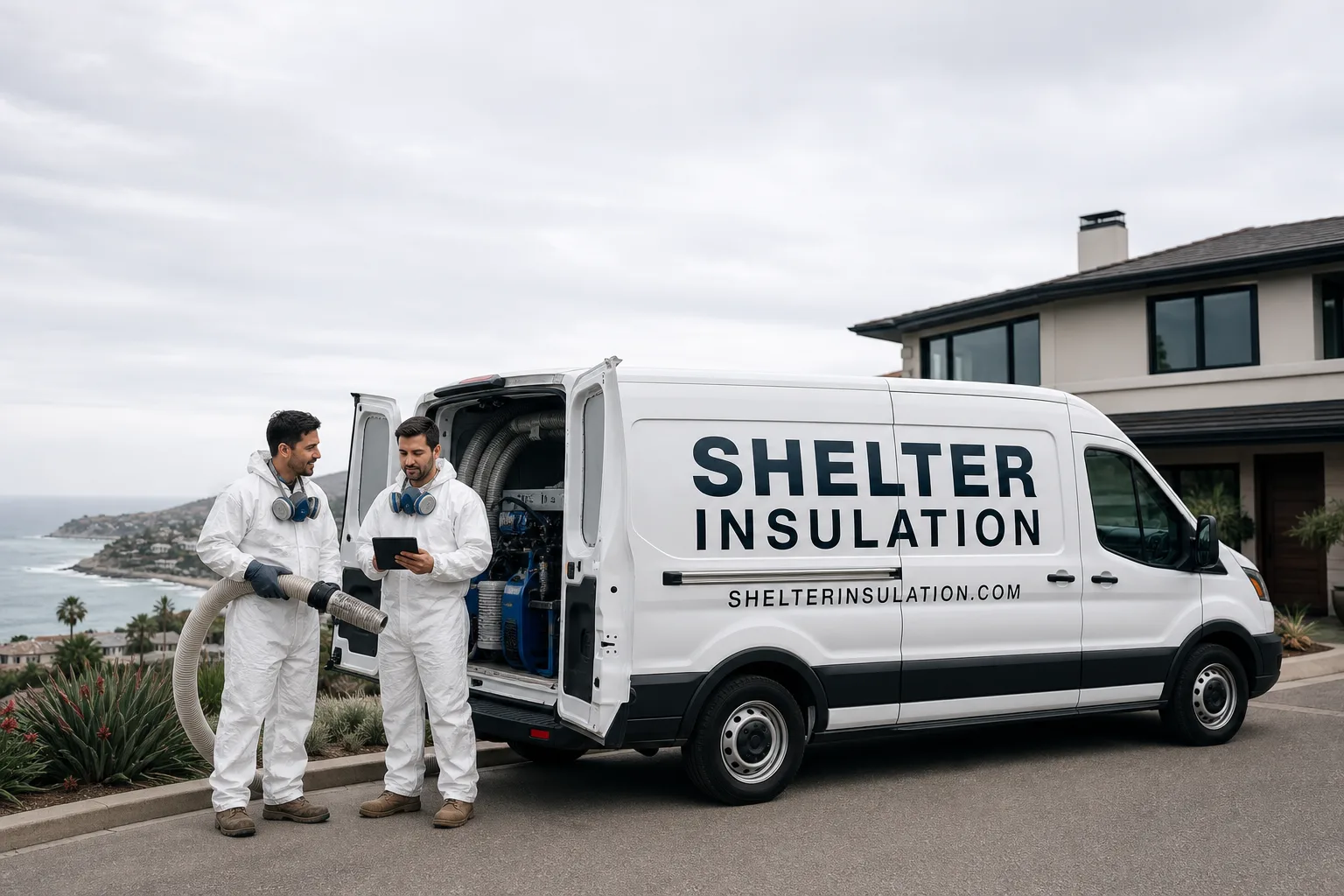
Fast, Reliable Attic Insulation Across Corona
Attic insulation in Corona does two jobs most coastal cities never ask of it: it fights 100°F-plus summer heat radiating through your roof deck, and it stands up to Santa Ana winds that push embers and ash against your home’s envelope. We get it because we work here. When your attic hits 150°F in July and your AC runs nonstop from noon to midnight, the problem is rarely your HVAC. It’s what’s between your ceiling and the roof. Our crews reach most Corona neighborhoods from Temescal Valley to the 92882 historic core within a day, and the call costs you nothing. Dial (855) 341-3373 for a straight answer on what your attic actually needs.
Why Shelter Insulation Is Corona’s Preferred Attic Insulation Company
Corona homeowners tend to ask sharper questions than most. They’ve lived through enough summers to know that an attic that hits 150°F is not normal, and they want specifics before anyone sets foot in their home. That’s the conversation Shelter Insulation is built for. Alan Brecker, who leads our team, keeps the focus on matching the right material to the house in front of us, not the product we happen to have in the truck that week.
Our Attic Insulation crews work across eight manufacturer lines because Corona’s housing stock demands it. A 1980s tract home in the 92879 corridor needs a different solution than a 1950s ranch off Grand Boulevard. One needs batts and air sealing. The other may need full removal and a radiant barrier. Carrying Owens Corning, Johns Manville, GreenFiber, Rockwool, Demilec, Icynene, CertainTeed, and Knauf means we’re not pushing a single product onto homes with different failure modes.
Single-contractor accountability matters here too. When attic insulation, spray foam, and blown-in work all fall to one crew, you’re not coordinating three different companies, three different warranties, and three different opinions. One call, one diagnosis, one point of contact for the whole job.
Attic Insulation Removal in Corona
Attic insulation removal in Corona is a full extraction of old, compromised material using a high-powered vacuum system, followed by sanitizing and preparing the attic deck for new insulation. Corona homeowners need this when their existing insulation has settled, compressed, been contaminated by rodents or wind-driven ash, or simply degraded past the point where adding more on top makes any sense. A typical removal in Corona runs $1.50 to $3.50 per square foot, depending on access and how much material is coming out. Removal is also the only correct first step when vermiculite or other suspect materials are present, a scenario we see frequently in the 92882 historic core.
When Removal Beats Topping Off
You don’t always need removal. If your batt insulation is intact but thin, a top-up makes sense and costs less. But in older Corona homes where loose-fill has settled to under R-7 or been compromised by pests, piling new insulation on top just buries the problem. The old material keeps off-gassing, keeps holding moisture, and keeps providing a home for whatever got in there. Removal is not an upsell. It’s the fix when the base layer is no longer a base.
What We Pull Out of Corona Attics
In 92882 ranch homes, we’re typically removing original cellulose or mineral wool that predates modern building codes. In 92883 foothill homes near the Temescal Valley edge, we’re more often removing blown-in fiberglass contaminated by ash and embers from brush fires. Both jobs end the same way: a clean attic deck that’s ready for the right material at full depth.
Insulation Contractors in Corona
Insulation contractors in Corona who know this city will tell you the same thing: the biggest mistake is treating insulation as a commodity. It’s not. The right material for a 1980s tract home with compressed R-30 batts in the 92879 corridor is different from what a newer 92883 foothill home with cathedral ceilings needs. Our crews diagnose before they quote. That means measuring current R-values, checking for air leakage at the ceiling plane, and looking at how your attic actually ventilates before recommending a single product.
One Crew for Every Method
Most insulation companies in Corona specialize in one installation method. They blow cellulose, or they roll batts, or they spray foam. Shelter Insulation runs all three from one crew, so the recommendation is based on your home, not our equipment. Blown-in reaches where batts can’t. Spray foam seals the building envelope in ways loose-fill never will. Rockwool adds fire resistance and sound damping that’s genuinely useful when the Santa Anas kick up. We carry all of it because your house might need any of it.
Why Local Diagnosis Matters
A Corona attic is not a Laguna Beach attic. The inland basin holds heat differently. The diurnal swing between scorching afternoons and cold winter nights stresses insulation in both directions. And the ember exposure from Cleveland National Forest foothill zones means fire-rated materials aren’t a sales add-on here. They’re the difference between an attic that resists the next Santa Ana event and one that doesn’t.
Trusted Brands We Service in Corona
We service and install products from Owens Corning, Johns Manville, GreenFiber, Demilec, Icynene, Rockwool, CertainTeed, and Knauf. That range matters in Corona specifically because the housing stock spans so many eras and failure modes. GreenFiber cellulose makes sense for older attics with irregular joist spacing. Owens Corning fiberglass batts are the workhorse for standard 1980s-2000s tract homes. Demilec and Icynene spray foam handle cathedral ceilings and air-sealing on newer 92883 builds where batt and loose-fill struggle. And Rockwool gives us an answer when fire resistance matters as much as R-value, which in the Santa Ana corridor it often does. We carry these brands because each solves a specific Corona problem, not because they fill a catalog page.
Common Attic Insulation Problems We See in Corona Homes
- Compressed R-30 batts in 1980s-2000s tract homes. The 92879/92880 corridor was built fast during the Inland Empire boom. Standard fiberglass batts have settled and compressed over 30-40 years, leaving gaps that let 150°F attic heat radiate straight into living spaces. The fix is usually full-depth replacement, not a cheap top-off.
- Minimal original insulation in 92882 historic-core homes. These 1950s ranches often shipped with R-7 or less, and what’s left has been degraded by decades of heat cycling and occasional rodent traffic. Full removal is nearly always the correct first step before re-insulating to R-38 or R-49.
- Ash and ember contamination in 92883 foothill developments. Wind-driven debris from nearby brush fires displaces and contaminates blown-in insulation along the Temescal Valley edge. Removal and replacement is the only reliable fix, not adding more material on top.
- Uneven temperatures between rooms under the same roof. This is the most common complaint we hear in Corona. A bedroom that runs 8-10 degrees hotter than the hallway usually points to insulation voids or compressed material above that room, not an HVAC balancing issue.
Pricing for Attic Insulation in Corona, CA
What you’ll pay depends on what’s up there now and what needs to go in. Here are real ranges for Corona’s market:
- Blown-in cellulose or fiberglass top-up over existing insulation: $1.20 to $2.50 per square foot installed.
- Full removal and replacement with R-38 fiberglass batts: $2.75 to $4.50 per square foot, including extraction, sanitizing, and disposal.
- Spray foam on the attic ceiling deck for new or remodeled 92883 homes: $2.50 to $5.50 per board foot depending on open-cell or closed-cell.
- Radiant barrier installation alongside new insulation: an additional $1.00 to $2.00 per square foot, typically on the roof rafters.
Your quote comes from what we actually measure in your attic, not from a phone estimate formula. Call (855) 341-3373 and we’ll walk the space, show you what’s up there, and price it on the spot. The estimate is free, and you’ll have a number you can make a decision with.
We Also Serve Cities Near Corona
Our crews work throughout the Inland Empire, including Home Gardens, El Cerrito Corona, Eastvale, and Norco. If you’re in a neighboring community and your attic is underperforming, the same diagnosis-first approach applies. Learn more about how we approach the work across our service area, including Attic Insulation in Corona and surrounding ZIP codes.
Serving Corona, CA — Our Local Coverage Area
We’re based in the Corona area and know this community well. Use the map below to see our service coverage — if you’re nearby, we can almost certainly help.
FAQs About Attic Insulation in Corona
Corona’s position at the convergence of the Santa Ana River corridor and the Santa Ana Mountains means hotter, longer summer heat loading than Riverside, and far less coastal marine-layer relief than Anaheim. Attic temperatures here routinely exceed 150°F, which accelerates batt compression and degrades loose-fill. Add the wide diurnal swing between day and night and the stress cycling is relentless. The insulation simply works harder in Corona. Call (855) 341-3373 and we’ll show you what yours looks like now.
Three signs warrant an inspection: rooms that run noticeably hotter than the hallway in summer, AC bills that climb year over year without a change in usage, and insulation you can see has settled well below the top of the ceiling joists. In 92879 tract homes, we regularly find R-30 batts compressed to R-19 or worse. If you’re seeing any of these, call us for a free attic evaluation before the next heat wave.
Usually not. Original 92882 homes typically have loose-fill that has settled to under R-7 and may be contaminated with rodent waste or moisture. Adding new insulation over compromised material buries the problem and creates a layer cake of old and new that rarely performs. Full removal is the right call for most historic-core Corona homes. We’ll confirm with a visual inspection before quoting any work.
Ash and embers infiltrate attic vents and settle into blown-in insulation, reducing its R-value and creating a potential fire-load hazard. In the 92883 foothill developments along Temescal Valley, we’ve pulled out inches of ash-contaminated material that looks fine from above but has no insulative integrity left. That’s a removal-and-replacement job, not a top-off. If you’ve had a brush fire within a few miles of your home, get the attic checked.
R-38 to R-49 is the range we recommend for most Corona homes, depending on the attic’s size and the home’s age. In 92882 historic homes with minimal original insulation and no radiant barrier, R-49 plus a radiant barrier makes a measurable difference in cooling load. In newer 92883 homes with decent existing insulation, R-38 with a radiant barrier typically gets you where you want to be. Call (855) 341-3373 for an exact recommendation based on your attic.
Written by Alan Brecker, Owner at Shelter Insulation, serving Corona and the Inland Empire.