
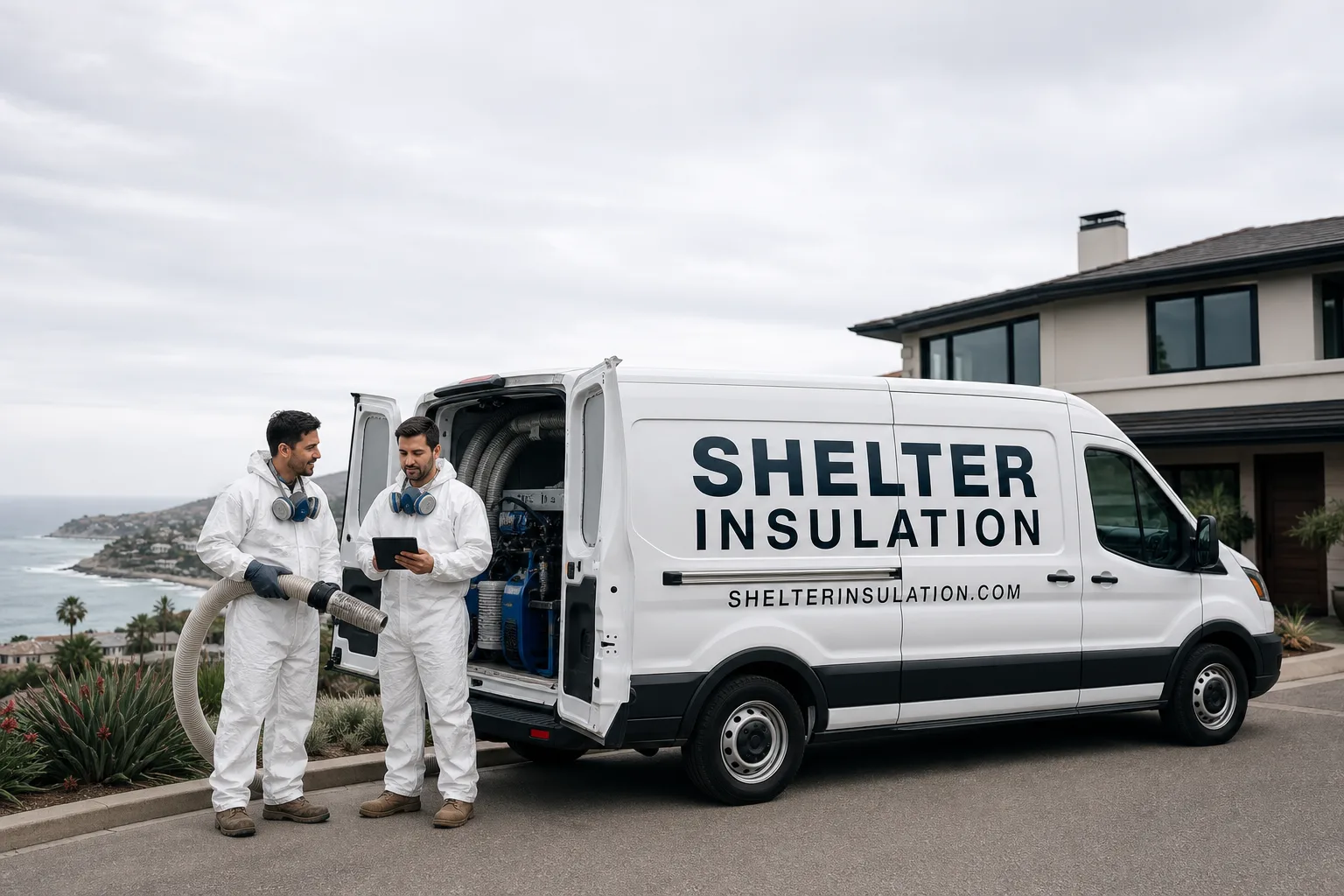
Fast, Reliable Attic Insulation Across Jurupa Valley
If your Jurupa Valley home was built between the 1950s and 1980s, there’s a strong chance your attic insulation has quietly failed. We’re talking original batts settled to three inches or less, sliced open during decades of rewiring and HVAC swaps, and an attic that bakes toward 150°F under dark shingles every summer afternoon. That’s the reality we see weekly in Jurupa Valley, from the ranch homes off Limonite Avenue to the tract neighborhoods near the 60. Shelter Insulation fixes it properly, and our crews know this city’s housing stock cold. Call (855) 341-3373 for a free attic assessment, and we’ll tell you straight what needs doing and what doesn’t.
Key Takeaways
- Most Jurupa Valley attics have settled legacy insulation at R-11 or lower, not modern R-38 to R-60 levels.
- Summer attic temperatures near the 60 freeway routinely hit 150°F, making ventilation and radiant barriers as important as insulation depth.
- Blown-in insulation reaches around old wiring, ductwork, and truss gaps that batts can’t seal.
- We carry fiberglass, mineral wool, spray foam, and cellulose, so the recommendation fits your home, not our inventory.
- Free estimates and one crew for every insulation method, including Attic Insulation, spray foam, and blown-in.
Why Shelter Insulation Is Jurupa Valley’s Preferred Attic Insulation Company
We’re a material-agnostic insulation specialist, and that matters more in Jurupa Valley than in newer cities. A 1950s ranch home near Pedley needs a different approach than a 1980s tract house off Van Buren Boulevard, and we don’t force either one into a single product line. Shelter Insulation carries eight manufacturer brands, including Owens Corning, GreenFiber, Icynene, and Demilec, because no single material solves every attic. That’s the whole point: the right material for your home’s specific challenge, not a one-size-fits-all upsell.
Local homeowners who’ve already worked with us in Glen Avon and Sunnyslope keep bringing us back for attic top-ups, radiant barrier retrofits, and ventilation corrections. Why? Because our one crew handles batt, blown-in, and spray foam work, so there’s one point of contact and one warranty conversation for the entire project. You don’t juggle three contractors who each blame the others when the upstairs still won’t hold setpoint in August.
Alan Brecker built Shelter Insulation around a simple observation: a home that’s sealed, protected, and comfortable year-round changes how a family lives in it. That’s what we deliver in Jurupa Valley, 91752, on every job from a basic top-up to a full legacy-batt replacement with radiant barrier.
Attic Ventilation in Jurupa Valley
Attic ventilation in Jurupa Valley isn’t an add-on; it’s the difference between an attic that holds heat like a pizza oven and one that actually releases the 150°F air trapped under dark asphalt shingles. We see this constantly in the post-WWII ranch homes along Mission Boulevard and the 60 freeway corridor: soffit vents painted over during a reroof, a single whirlybird that can’t move enough air, or no ridge vent at all. The result is a hot ceiling plane radiating into the living space all afternoon, forcing your AC to fight a battle it can’t win.
When Ventilation Gets Priority Over More Insulation
If your Jurupa Valley attic already has R-19 or better but rooms below still spike in the afternoon, more insulation won’t fix the problem. The heat load is coming from trapped air, not conduction through the ceiling. Adding balanced intake and exhaust ventilation, sized to the attic’s square footage, drops that air temperature enough that your existing insulation can actually do its job.
What Ventilation Corrections Cost Here
For homes in Jurupa Valley, adding ridge and soffit ventilation typically runs $850 to $1,600 depending on attic size and existing roof structure. If we’re already in the attic installing blown-in insulation or a radiant barrier, combining the work makes far more sense than pulling a crew back twice. A proper vent upgrade can reduce attic temperatures by 20 to 30°F on a 100°F day.
Radiant Barrier in Jurupa Valley
Radiant barrier in Jurupa Valley is one of the highest-return retrofits available for homes near the 60, where summer attic temperatures hit 150°F by noon and stay there until evening. A radiant barrier is a reflective material stapled to the underside of the roof rafters, blocking radiant heat from shingles and sheathing before it can radiate down into the attic air and through your ceiling insulation. In an inland climate like Jurupa Valley’s, with almost no marine cooling and regular Santa Ana wind days, the physics work in your favor all summer.
Is a Radiant Barrier Worth It on an Older Home?
On post-WWII and 1970s-80s tract homes with minimal original insulation, yes, but only after the ceiling plane is properly air-sealed and insulated. The barrier handles radiant heat; blown-in insulation handles conductive heat. Skip either one and you’re leaving a gap the other can’t cover. We carry radiant barriers from manufacturers whose products are rated for attic use in high-heat climates like the Inland Empire.
Realistic Pricing for Jurupa Valley Installations
A radiant barrier installation in Jurupa Valley typically runs $1,200 to $2,400 for a standard single-story ranch attic. Two-story homes or attics with complex truss layouts run higher because the rafters are harder to access. The cost often pays for itself within two to three cooling seasons, especially when combined with attic ventilation and an insulation top-up.
Trusted Brands We Service in Jurupa Valley
Shelter Insulation is authorized to install products from eight manufacturer brands, and we keep the local Jurupa Valley projects moving because we’re not waiting on a distributor to ship from across the country. We carry GreenFiber cellulose because blown-in reaches where batts can’t, especially through the odd joist spacing and old wiring runs common in 1960s ranch homes. We carry Owens Corning because their fiberglass batts and blown-in products have proven themselves across decades of Inland Empire summers. And we carry Icynene and Demilec spray foam because some Jurupa Valley homes need air-sealing performance that traditional materials alone can’t deliver. One crew, every insulation need.
Common Attic Insulation Problems We See in Jurupa Valley Homes
- Settled 1950s-60s batts at R-11 or lower. Original insulation in the neighborhoods off Mission Boulevard and Limonite Avenue has often compressed to three inches or less, leaving the ceiling plane nearly unprotected. Decades of HVAC and electrical work have sliced, lifted, and flattened the batts, creating thermal gaps you can feel from the living room on a hot afternoon.
- Attics baking toward 150°F with no meaningful ventilation. Dark asphalt shingles absorb solar heat all day, and without balanced soffit-to-ridge airflow, that heat pours into the living space. Many Jurupa Valley homes have vents that were blocked or painted over during past reroofs.
- Air leaks at ceiling penetrations, wiring chases, and can lights. The same era of construction that gave Jurupa Valley its ranch-style charm also left dozens of unsealed holes between house and attic. Insulation can’t stop airflow, so these leaks keep pulling conditioned air out and pushing hot attic air in.
- Ductwork and wiring running directly through the attic floor. Old flex duct and bundles of Romex make batt replacement messy but are barely an obstacle for blown-in cellulose or fiberglass. The trick is air-sealing the ceiling plane first, then insulating over and around everything without compressing the material.
Pricing for Attic Insulation in Jurupa Valley, CA
A full attic insulation replacement for a typical Jurupa Valley ranch home, air-sealing included, generally runs $2,400 to $4,800 depending on square footage and the condition of existing material. If we’re doing a top-up over settled batts, expect $1,200 to $2,200 for blown-in fiberglass or cellulose to bring the attic to R-38 or R-49. Attic baffles and ventilation prep add $300 to $700 when done as part of the insulation job. Radiant barrier installation lands at $1,200 to $2,400 as described above. We give a written, itemized quote before any work begins, and the estimate is free. Call (855) 341-3373 to schedule yours, and we’ll measure the actual attic, not guess from a floor plan.
We Also Serve Cities Near Jurupa Valley
While much of our week is spent crawling through Jurupa Valley attics, we regularly cross into Glen Avon, Pedley, Sunnyslope, and Eastvale. If you’re just over the city line and wondering whether we cover your street, the answer is usually yes. For the full picture of what we do, see Attic Insulation in Jurupa Valley. Our crews live in the region, which is exactly why we understand what a 150°F attic does to a home built in 1962.
Serving Jurupa Valley, CA — Our Local Coverage Area
We’re based in the Jurupa Valley area and know this community well. Use the map below to see our service coverage — if you’re nearby, we can almost certainly help.
FAQs About Attic Insulation in Jurupa Valley
Almost always, replacement beats trying to save it. Original 1960s batts in Jurupa Valley homes have typically settled to three inches or less, been sliced through during decades of rewiring and HVAC work, and may contain gaps that add up to an entire missing batt row. Air-sealing the ceiling plane and blowing in new insulation over the old, or removing the old entirely, is the standard fix we recommend. Costs for a full replacement start around $2,400 for a single-story ranch. Call (855) 341-3373 for an exact assessment.
A Jurupa Valley attic with dark shingles and limited ventilation routinely hits 140 to 150°F by midday in July and August, especially near the 60 freeway corridor where there’s no marine air movement. That heat load means you need three things working together: R-38 or better insulation for conduction, balanced ventilation to move trapped air, and ideally a radiant barrier to block shingle heat before it enters the attic. Insulation alone can’t keep up with 150°F air sitting directly above your ceiling.
It genuinely helps, and in Jurupa Valley’s climate it’s not overkill. A radiant barrier blocks radiant heat transfer from hot shingles and sheathing, which is the dominant heat source in an Inland Empire attic. The Department of Energy has long recognized radiant barriers as effective in hot, sunny climates. On a 100°F day, a properly installed barrier can cut attic temperatures by 20 to 30°F, which directly reduces the heat pulled through your ceiling insulation. Expect to pay $1,200 to $2,400 for a typical ranch attic.
Yes, and that’s exactly the case where blown-in insulation outperforms batts. Loose-fill cellulose or fiberglass settles naturally around wires, flex duct, plumbing vents, and odd joist spacing without leaving the gaps that cut and tucked batts create. We air-seal around every penetration first to stop the air leaks, then blow insulation to the target depth, keeping it clear of can lights and open-flue hardware. Old wiring is not an obstacle for the material or the crew.
Because the house is fighting more than one problem at once. Older Jurupa Valley tract homes near the 60 often have single-pane windows, wood-framed walls insulated to R-11 or less, and attics that need both ventilation and radiant barrier work. One insulation upgrade fixes the ceiling plane but the other losses remain: heat radiating through single-pane glass, air leaking past old window seals, and walls that conduct solar gain into the house. The ceiling is the floor of the problem, not the whole problem. A full assessment shows which of these is actually driving your cooling bill before you spend on the wrong fix.
If you’re tired of running the AC nonstop through every Jurupa Valley summer and still feeling the heat soak through the ceiling by 3 p.m., give us a call. Alan Brecker and the Shelter Insulation crew will measure, quote, and finish the job right. Call (855) 341-3373 for a free estimate, or just to ask what’s actually going on up in your attic.
Written by Alan Brecker, Owner at Shelter Insulation, serving Jurupa Valley and the surrounding Inland Empire.