
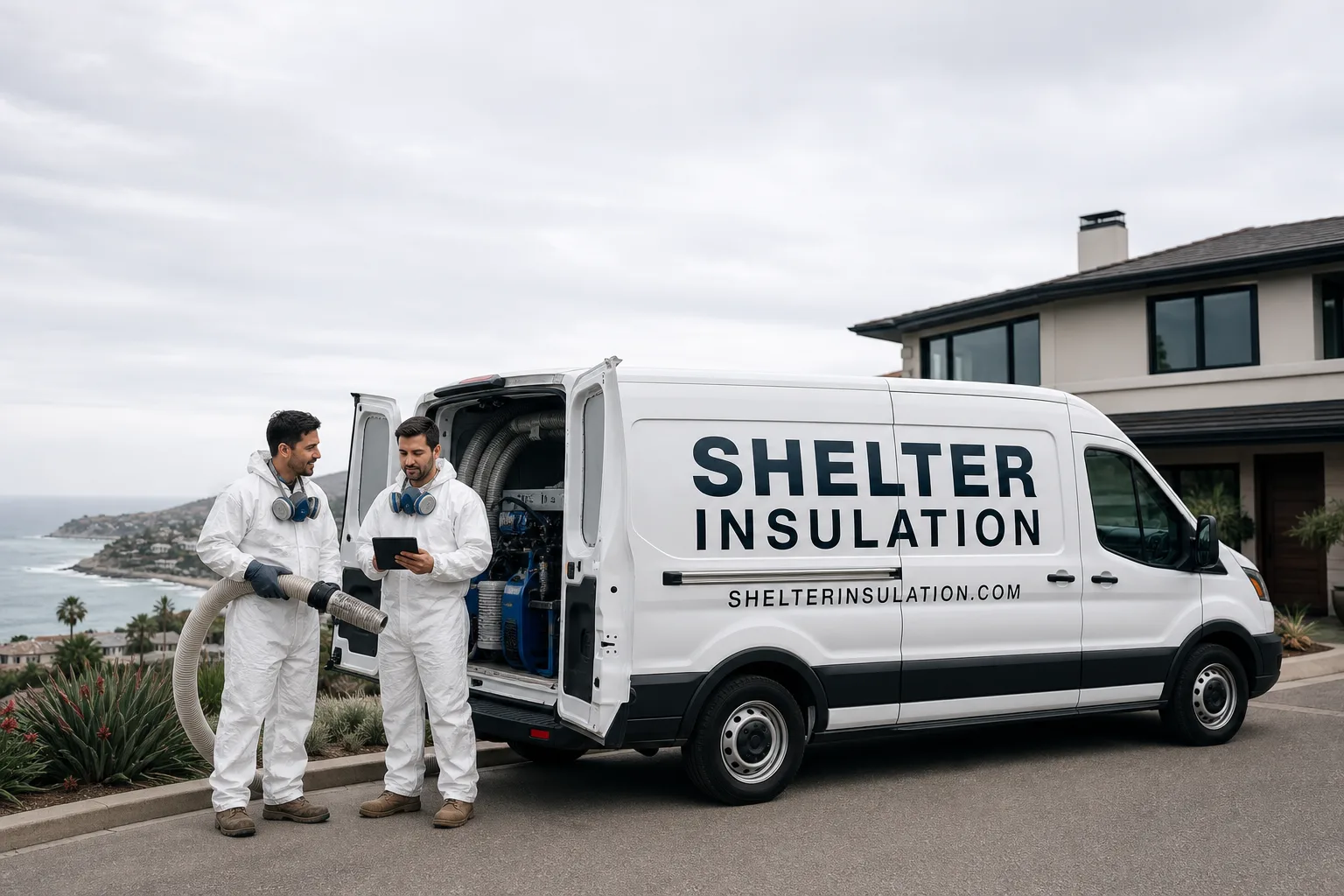
Fast, Reliable Attic Insulation Across San Joaquin Hills
Attic insulation in San Joaquin Hills typically costs $1,800 to $4,200 for a full replacement in a standard 3,000 to 4,000 square foot home, and we can usually schedule within 3 to 5 business days. If you’re noticing upstairs rooms that won’t hold temperature or cooling bills that climb every summer, the problem is often what’s happening above your ceiling. Our crews know the canyon-side tracts off Newport Coast Drive and the gated enclaves off Ridge Park Road, and we answer our own phone at (855) 341-3373 when you call.
What makes San Joaquin Hills different from Newport Beach or Irvine is the combination of steep lots, older insulation, and real wildfire exposure. Those three things change how an attic should be insulated, and they’re why generic advice doesn’t always hold up here. We’ll get into the specifics below.
Why Shelter Insulation Is San Joaquin Hills’s Preferred Attic Insulation Company
Homeowners in San Joaquin Hills tend to do their homework before hiring anyone. They ask about R-value, they ask about venting, and they want to know why one material beats another for their specific roofline. That’s exactly the conversation we’re built for. Alan Brecker started Shelter Insulation around a simple idea: carry the right materials, install them correctly, and explain the reasoning without talking down to anyone.
We’re authorized to install products from eight manufacturers, including Owens Corning, GreenFiber, and Rockwool, and we also offer Reflectix service in San Joaquin Hills. That matters more than it sounds. A company that only pushes one product will recommend that product whether or not it fits your attic. We don’t have that constraint. If blown-in cellulose is the right call for a tight attic with odd framing, we’ll say so. If mineral wool makes more sense because of fire resistance near the wildland-urban interface, we’ll tell you that too.
For San Joaquin Hills specifically, we’re familiar with what happens to attics built in the 1980s through 2000s. We’ve worked on custom Mediterranean homes off Bonita Canyon Drive and larger estates near the San Joaquin Hills Transportation Corridor. Every neighborhood has slightly different construction quirks, and we’ve learned them by being inside these attics, not by reading about them.
Attic Mold Removal in San Joaquin Hills
Attic Mold Removal in San Joaquin Hills is a service we handle regularly because the marine layer that rolls in from the coast meets hot attic air and creates condensation on the underside of roof sheathing, especially in homes where bathroom fans or dryer vents discharge into the attic instead of outside. Homes built in the 1980s and 1990s here often have exactly that problem, and it’s the leading cause of attic mold we see. A full attic mold removal and treatment for a typical San Joaquin Hills home runs $1,200 to $3,500 depending on the square footage of affected sheathing.
What Removal Involves
We remove contaminated insulation, treat the framing and sheathing with an EPA-registered antimicrobial, and then address the source of the moisture so it doesn’t come back. The source matters more than the mold itself. If a bathroom fan is venting into the attic, cleaning mold without fixing that vent is wasted money.
When to Act
If you smell a musty odor when you open the attic hatch or you see dark staining on the underside of the roof deck, don’t wait. Mold spreads through porous wood quickly, and the remediation cost climbs with the affected area. In San Joaquin Hills, where many homes have multiple attic zones and vaulted ceiling sections, mold can hide in spots you can’t see from the access point. A professional inspection is the only way to know the true extent.
Attic Insulation Removal in San Joaquin Hills
Attic Insulation Removal in San Joaquin Hills is often the first step before a re-insulation project because original R-19 fiberglass batts from the 1980s and 1990s have usually settled, been walked on during HVAC work, or been displaced by contractors running new ductwork. In attics where the insulation has compressed or shifted, the R-value you think you have isn’t the R-value you’re getting. Removal and disposal for a standard San Joaquin Hills attic runs $900 to $2,200, and it’s a prerequisite for any proper re-insulation job where the existing material is compromised.
Why Removal Beats Topping Up
Some companies will offer to blow new insulation over old, degraded batts. That can work in a clean, dry attic where the original material is still performing. But in many San Joaquin Hills homes, especially those where the roof has leaked at some point or rodents have nested, the old insulation is contaminated and should come out. You don’t want new insulation sitting on top of rat droppings or mold spores.
Steep Pitch Access Challenges
The steep roof pitches common in San Joaquin Hills make full removal more labor-intensive than in a tract home with a shallow roofline. Our crews use proper fall protection and attic walk boards to work safely across the joists without compromising the integrity of the ceiling below. We’re set up for that kind of job, and we staff it accordingly.
Trusted Brands We Service in San Joaquin Hills
We’re authorized installers for Owens Corning, Johns Manville, and GreenFiber, among others, so when you call us about attic insulation in San Joaquin Hills, you’re not locked into whatever happens to be on the warehouse shelf that week. We stock GreenFiber cellulose for blown-in applications in tight, irregular attic spaces, and we regularly specify Owens Corning fiberglass batts for straightforward open attics where air sealing and venting are already in good shape. Johns Manville’s mineral wool line, which carries strong fire-resistance ratings, gets specified more often here than in most cities because of the wildfire exposure along the canyons. We keep all of it sourced and ready for San Joaquin Hills jobs, which means less waiting between the estimate and the install date.
Common Attic Insulation Problems We See in San Joaquin Hills Homes
- Settled or displaced original R-19 batts. Homes built in the 1980s through 2000s often have fiberglass batts that were installed at R-19, which is well below today’s Title 24 minimums. Add in HVAC retrofits that moved or compressed the batts, and the effective R-value drops further. We find gaps around air handlers and duct runs in almost every retrofit attic we open in San Joaquin Hills.
- Ember intrusion through unprotected attic vents. The wildland-urban interface along the canyon edges means ember-resistant venting is not optional. Standard mesh or open gable vents allow wind-driven embers into the attic during a wildfire event. We install ember-resistant mesh and, where appropriate, fire-rated insulation materials like mineral wool.
- Intense solar gain on south and west-facing tile roofs. Afternoon sun beats on those tile roofs for hours, pushing attic temperatures past 140°F in summer. That heat degrades insulation over time and forces your AC to work harder. Proper attic ventilation and the right insulation thickness make a measurable difference in cooling costs.
- Vented bathroom fans and dryer exhausts discharging into the attic. This is common in 1980s and 1990s construction throughout San Joaquin Hills, and it pumps warm, moist air directly into the insulation. The result is mold growth and reduced insulation performance. We correct the venting when we re-insulate.
Pricing for Attic Insulation in San Joaquin Hills, CA
A full attic insulation replacement in San Joaquin Hills typically runs $1,800 to $4,200 for a home between 3,000 and 4,000 square feet, assuming standard access and no major framing obstacles. Attic insulation removal alone runs $900 to $2,200, while attic mold removal ranges from $1,200 to $3,500 depending on the affected area. Adding blown-in insulation over existing material where the old batts are still sound runs $1,100 to $2,000. Steep-pitch attics, vaulted ceilings, and tight access points add labor, and homes over 5,000 square feet land higher on these ranges. The best way to get an exact number is to call (855) 341-3373 and schedule a free attic inspection. We walk the attic, take measurements, and give you a written quote before any work starts.
We Also Serve Cities Near San Joaquin Hills
Our crews work throughout the coastal and canyon communities around Attic Insulation projects in Aliso Viejo, Newport Beach, Laguna Beach, and Irvine. If you’re in one of those cities and need the same level of material-agnostic, code-aware attic work, we can help. Call (855) 341-3373 and we’ll get you scheduled.
Serving San Joaquin Hills, CA — Our Local Coverage Area
We’re based in the San Joaquin Hills area and know this community well. Use the map below to see our service coverage — if you’re nearby, we can almost certainly help.
FAQs About Attic Insulation in San Joaquin Hills
Attic insulation in San Joaquin Hills matters more than in flat inland cities because the canyon terrain and coastal-influenced climate create extreme temperature swings, and the wildland-urban interface adds a fire-hardening dimension that newer inland developments don’t face. Hot afternoon sun on tile roofs drives attic temperatures high, which degrades insulation and forces air conditioners to work harder. In addition, homes along the canyon edges are exposed to ember intrusion during wildfire events, which means the choice of insulation material and venting details has a safety component. Proper insulation here is about both comfort and resilience.
Call (855) 341-3373 for an attic assessment specific to your home’s location and construction year.
For most San Joaquin Hills homes, we recommend R-38 to R-49 for attic floors, which exceeds the current California Title 24 baseline of R-30 for climate zone 8. The reason is simple: our summers run hot, and the difference between R-30 and R-38 is noticeable in cooling costs when your attic is hitting 140°F in August. In some larger homes with vaulted ceiling sections and limited attic depth, a spray foam application on the roof deck may be a better path to effective R-value than batts on the floor. We’ll evaluate your specific attic geometry before recommending a number.
Call (855) 341-3373 and we’ll assess your attic and confirm what’s actually up there now.
Yes, for most San Joaquin Hills homes we remove old insulation and install new insulation in the same visit, assuming the attic is dry and no mold remediation is required. The process typically takes one to two days depending on attic size, roof pitch, and how much material needs to come out. If we find mold or a venting defect during removal, we’ll adjust the plan and tell you before proceeding. That rarely extends the job by more than a day.
Call (855) 341-3373 to schedule a removal and replacement estimate.
We address ember intrusion by replacing standard attic vents with ember-resistant mesh or, in some cases, by specifying mineral wool insulation near vent openings, and we recommend this upgrade for any San Joaquin Hills home in the wildland-urban interface. Standard 1/4-inch mesh won’t stop wind-driven embers. The ember-resistant mesh we install is rated to block ember entry while still allowing adequate airflow for ventilation. For homes along the canyon edges where exposure is highest, we’ll also discuss whether a fire-rated insulation material like Rockwool makes sense for your attic assembly.
Call (855) 341-3373 for an ember-risk assessment of your attic vents.
Yes, steep roof pitches in San Joaquin Hills make attic insulation installation more labor-intensive and more safety-critical than in homes with shallow roofs, because crews need fall protection, attic walk boards, and careful navigation around framing. We don’t cut corners on safety equipment, and we don’t send a single worker into a steep attic alone. That’s part of why we cost slightly more than the low-bid generalist, and it’s also why our work holds up. We’d rather do the job right from the walk boards than rush it and risk a ceiling crack or an injury.
Call (855) 341-3373 to talk through your attic’s specific pitch and access.
What Makes This Page Different
Most attic insulation pages are written for a generic American suburb. They don’t mention that San Joaquin Hills has original R-19 batts that have settled in thousands of attics, or that HVAC contractors routinely displace insulation when they add air handlers and duct runs. They don’t address ember intrusion through attic vents, and they don’t talk about the steep canyon lots that make attic work genuinely difficult and occasionally unsafe for crews that aren’t equipped for it. This page does, because we work here. On a 1990s Mediterranean home off Newport Coast Drive, we found original R-19 batts sagging away from the roof deck and displaced around a recently added HVAC air handler. After removing the failed insulation, we installed Rockwool batts to achieve R-38 and sealed attic vents with ember-resistant mesh, reducing attic temperatures by 15°F on a 95°F afternoon. That’s the kind of result that matters when your AC is running nonstop in July, and it’s the kind of job we do regularly in Attic Insulation in San Joaquin Hills.
Written by Alan Brecker, Owner at Shelter Insulation, serving San Joaquin Hills attic insulation projects from our base in Laguna Beach, CA.