
Johns Manville Attic Insulation in Laguna Beach: A Homeowner’s Guide
Johns Manville attic insulation in Laguna Beach is not one product. It’s a family of fiberglass lines – ComfortTherm batts, Climate Pro blown fiberglass, and SpiderGlas spray-applied fiberglass – with R-values, vapor behaviors, and installation methods different enough that choosing the wrong one for a coastal attic means paying twice: once for the material, and again in higher bills or moisture problems you didn’t expect. Getting the call right starts with knowing which JM product actually fits your rafters, your ceiling geometry, and your home’s exposure to marine air.
At high level: most Laguna Beach homes built before 2000 are under-insulated by today’s code standards, and many have original R-19 or R-30 fiberglass that has compacted decades past its labeled value. Whether you’re topping off an existing attic or insulating a new one from scratch, the JM product line deserves a closer look before any contractor picks a SKU for you. And if you’d rather skip the deep dive and just talk specifics about your home, call Shelter Insulation at (855) 341-3373 for a free attic assessment. We’ll tell you honestly what we’d put in our own attic, and why.
Key Takeaways
- Johns Manville makes three distinct attic product families: ComfortTherm batts (kraft-faced and encapsulated), Climate Pro blown fiberglass, and SpiderGlas spray-applied fiberglass with fundamentally different performance profiles.
- Laguna Beach’s marine humidity and wide temperature swings mean vapor-control choices – not raw R-value – often determine whether an attic insulation job succeeds or creates hidden problems.
- JM’s encapsulated batts (no separate vapor retarder) behave very differently from kraft-faced batts in coastal attics, and knowing when to use which is more important than brand loyalty.
- Fiberglass is not always the right answer. In some Laguna Beach attic conditions, mineral wool or cellulose outperforms JM fiberglass on moisture resilience, air-infiltration resistance, or fire safety.
- A contractor who defaults to a single Johns Manville SKU without discussing your attic geometry, moisture history, or ventilation should have to answer more questions.
Johns Manville’s Product Families for Laguna Beach: Which One Goes Where
The first thing to understand is that “Johns Manville attic insulation” is a category, not a specification. We regularly see three different JM products specified for attics in Laguna Beach, and each has a defensible use case – plus conditions where it’s the wrong tool for the job.
ComfortTherm Batts are pre-cut fiberglass batts that come in two facing configurations: kraft-faced (with a paper vapor retarder) and encapsulated (fully wrapped in plastic film, no separate vapor retarder). They fit standard 16-inch or 24-inch on-center framing. For a flat, accessible attic over a finished ceiling, ComfortTherm is a common retrofit because it’s straightforward to lay over existing insulation or between joists. But batt performance depends heavily on installation quality: gaps at rafter edges, compressed batts around plumbing or electrical, and uneven joist spacing all reduce the effective R-value well below the label.
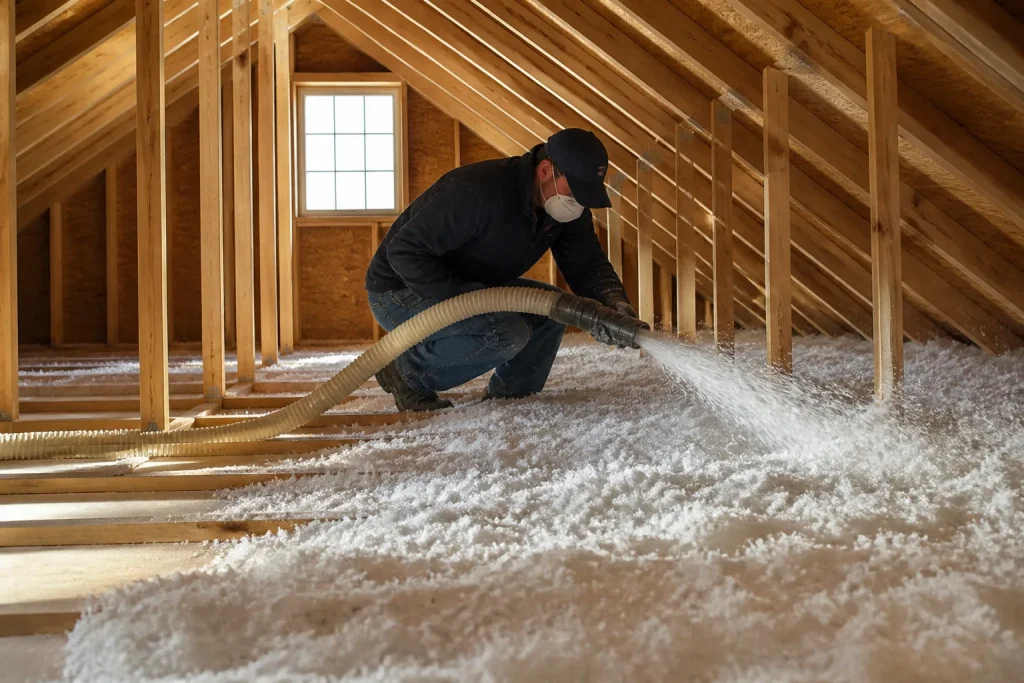
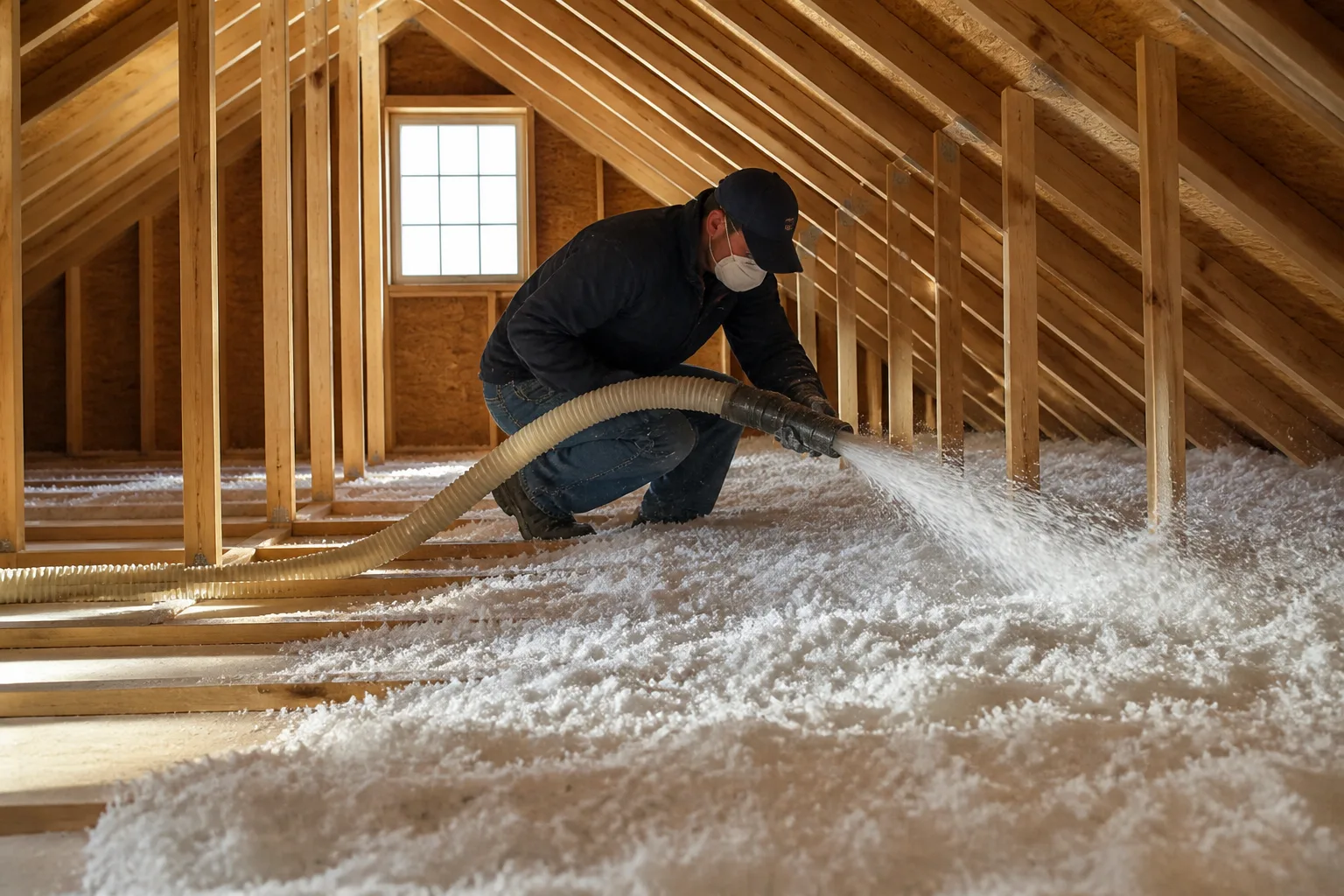
Climate Pro Blown Fiberglass is loose-fill, pneumatically blown fiberglass designed for open attics with flat horizontal ceilings. It’s the workhorse for topping off existing insulation in Laguna Beach – it fills irregular joist bays, conforms around framing, and achieves specified R-value by density rather than by batt thickness. In our experience, Climate Pro is the JM product we most often recommend for Laguna Beach attics with straightforward geometry and existing insulation that just needs a performance boost.
SpiderGlas is a spray-applied fiberglass system using adhesive and loose fiberglass blown into wall and ceiling cavities, then trimmed flush. It’s uncommon in attics, but shows up in some Laguna Beach hillside homes where sloped ceilings and rafter bays leave no accessible flat attic to insulate from above. SpiderGlas installed in rafter bays offers better fill and less settling than any batt, with similar thermal performance per inch to other fiberglass products.
The honest takeaway: your attic’s geometry and your home’s moisture profile matter more than the brand. JM builds good products, but any of them can be a poor fit if the installer defaults to what’s in the truck.
How Coastal Humidity Changes the Batt Conversation
Laguna Beach’s climate is not like Anaheim’s. The marine layer that rolls through June and July means attics here see more sustained ambient humidity than inland attics do, even though daytime temperatures stay milder. That makes vapor-retarder decisions in the attic more consequential than most contractors discuss.
Kraft-faced ComfortTherm batts have an asphalt-impregnated paper facing that acts as a vapor retarder. It’s designed to limit moisture migration from the warm side of the assembly (the living space below) into the attic cavity. That’s fine in a heating-dominated climate where the goal is keeping interior moisture out of the attic. But in Laguna Beach, where cooling and marine humidity dominate the energy profile, the vapor equation flips. The moisture concern is not “warm, humid air rising into a cold attic.” It’s “moist marine air entering the attic through vents and being trapped against a cold surface or absorbed by insulation that can’t dry out.”
JM’s encapsulated ComfortTherm batts handle this differently. The poly film encapsulation does not include a vapor retarder – instead, it provides a clean, low-dust, non-irritating installation surface with no paper facing to trap moisture against the insulation. For Laguna Beach attics, especially vented attics with strong air movement, encapsulated batts are often the safer JM batt choice because they dry more readily and don’t introduce a vapor retarder on the wrong side of the assembly.
That said, both kraft-faced and encapsulated batts still leave seams at every framing member. Air leakage through those seams is a bigger energy loss driver than the R-value itself in many older Laguna Beach homes, which is why we sometimes recommend air-sealing the attic floor before any insulation goes down.
Climate Pro and the Geometry Problem in Laguna Beach Hillside Homes
Climate Pro’s specification is based on installed density: bags list coverage per square foot at a given R-value, and the installer’s blowing rate and technique determine whether the actual installed R-value matches the spec. In flat, open attics – the typical 1970s and 1980s Laguna Beach homes near downtown and along Coast Highway – this is straightforward and dependable. Blow to depth, check coverage, done.
But Laguna Beach has a lot of hillside architecture: sloped ceilings, shallow rafter bays, dormer intersections, and attic spaces that are less “room above the garage” and more “crawl space angled at 30 degrees.” That’s where blown fiberglass gets tricky.
In shallow rafter bays, blown fiberglass can’t physically achieve the depth required for R-38 or R-49. The material settles some after installation anyway – typically 2 to 4 percent in an attic, more in sloped applications – and in a shallow bay, any settling is proportionally more significant. Climate Pro also doesn’t air-seal: it slows air movement through the insulation but doesn’t stop it. For hillside homes with complex rafter bays and roof-to-attic air paths, JM Climate Pro may not be the highest-performance choice regardless of how carefully it’s installed.
The right question to ask isn’t “what R-value should I buy?” It’s “what is the actual installed R-value my attic geometry can support, and what material achieves the highest real-world performance in that space?” If the answer doesn’t account for your ceiling geometry and air paths, you’re talking to a materials rep, not an insulation specialist.
Materials Have Off-Brands, Not Just Off-Days: When JM Fiberglass Isn’t the Best Fit
Here’s the thing fiberglass manufacturers don’t put on their spec sheets: sometimes another material is the better answer for a specific Laguna Beach attic, and any honest insulation expert should say so. We carry Johns Manville because it makes some of the best fiberglass on the market, but we also carry Shelter Insulation home services across other materials for the conditions where fiberglass underperforms.
Rockwool mineral wool, for example, outperforms any fiberglass batt we know of in fire resistance and dimensional stability. For a Laguna Beach hillside home in a high-fire-risk zone, adding mineral wool in the attic’s most vulnerable sections – or throughout, depending on budget – can be a defensible upgrade over JM fiberglass. It also sheds less when cut, which matters in attics where we’re working around HVAC ducting and electrical.
Cellulose from GreenFiber offers better air-infiltration resistance than fiberglass in many retrofit situations, because the material’s density and fibrous structure reduce air movement through the insulation itself. In attics with lots of irregular framing, old knob-and-tube wiring remnants, or deep cavities, we sometimes specify cellulose over Climate Pro simply because it fills irregular spaces more predictably and resists air movement better after installation.
That’s not a knock on Johns Manville. It’s a material truth: no single fiberglass product is the best answer in every attic condition. If a contractor can’t tell you when they’d choose something else, they’re not really choosing – they’re defaulting.
When to Call a Pro: Attic Work Is Not a Weekend Project
Before we go further, a safety caveat. Attic insulation work in Laguna Beach involves several risk factors worth taking seriously: confined, hot spaces; ceiling joists that may not support full body weight; and the presence of older electrical wiring, old knob-and-tube, or vermin droppings from years of attic life. If your attic has evidence of pests or deteriorating wiring, stop and have a professional assess it. Do not crawl around an attic you don’t know well. We’ve opened attics in Laguna Beach where a previous homeowner had already partially fallen through the ceiling and patched it from below without telling anyone. If you’re not sure, call a professional. At Attic Insulation in Anaheim, we do attic assessments year-round and we’ll tell you honestly whether you need insulation, air sealing, or something else entirely.
Questions to Ask a Contractor Who Defaults to One JM SKU
If you’re getting quotes for Johns Manville attic insulation in Laguna Beach and every bid is for the same JM product line without anyone asking about your attic conditions, use these questions to separate installers from order-takers:
- “Why this JM product for my attic?” If the answer doesn’t mention your ceiling type, rafters, ventilation, or moisture history, it’s not a specification. It’s a default.
- “What installed R-value can my attic geometry actually achieve?” A real answer considers rafter depth, joist spacing, and access constraints. “We’ll blow R-38” without checking the space is a guess.
- “What are you doing about air sealing?” Insulation without air sealing wastes a meaningful portion of the energy performance. If they don’t mention it, ask whether air sealing is included or quoted separately.
- “Would you use a different material anywhere in this attic?” If the answer is no across the board, on every attic, for every home, treat that as a red flag. Material-agnostic expertise means knowing when to say “not fiberglass.”
Shelter Insulation carries Johns Manville, Owens Corning, Knauf, Rockwool, CertainTeed, Icynene, Demilec, and GreenFiber. We carry eight brands precisely because no single one is the right answer for every home. For Laguna Beach attics specifically, where moisture, geometry, and fire risk vary block by block, that material flexibility matters.
Related services we handle in Laguna Beach: Spray Foam Insulation in Anaheim – including Icynene and Demilec open- and closed-cell systems – and Blown In Insulation in Anaheim, which covers both fiberglass and cellulose for attics with irregular geometry.
The Bottom Line
Johns Manville makes solid insulation products, and for many Laguna Beach attics, a JM Climate Pro blown fiberglass or ComfortTherm batt installation is a perfectly good choice – provided the installer specifies it correctly for your home’s actual conditions. The distinction that matters isn’t “Johns Manville vs. another fiberglass brand” as much as it is “the right JM product vs. the wrong JM product for this specific attic.”
If your attic has flat ceiling geometry, good ventilation, and no moisture history, JM Climate Pro blown fiberglass will likely serve you well. If you have a sloped ceiling, rafter bays, or a high-fire-risk zone, the conversation should include mineral wool, spray foam, or cellulose – and a knowledgeable installer will bring those up without being asked.
If you’re in Laguna Beach and want an honest material-agnostic assessment of your attic, Shelter Insulation offers free estimates. We’ll look at your attic, tell you what we’d install and why, and give you a written quote – no pressure, no upsell. Call (855) 341-3373 to schedule a visit.
Frequently Asked Questions
What is the best Johns Manville attic insulation for Laguna Beach homes? For most flat-ceilinged, vented attics in Laguna Beach, JM Climate Pro blown fiberglass offers the best combination of coverage, installed R-value certainty, and cost. For sloped ceilings or rafter bays, Climate Pro is trickier to install correctly, and ComfortTherm batts or another material type may serve better depending on the specific geometry.
Is Johns Manville insulation good for coastal humidity? JM’s encapsulated batts handle coastal humidity better than kraft-faced batts because they don’t add a vapor retarder that can trap moisture on the wrong side in a marine climate. But insulation alone doesn’t solve attic moisture – ventilation and air sealing matter just as much. Call (855) 341-3373 if you want us to check your attic’s moisture behavior before you buy anything.
How much does Johns Manville attic insulation cost in Laguna Beach? Material costs for JM Climate Pro blown fiberglass run roughly $0.50 to $0.80 per square foot for R-38 coverage, with ComfortTherm batts slightly higher per square foot at equivalent R-value. Full installed costs in Laguna Beach vary with access difficulty; hillside attics with limited headroom or sloped bays run higher than open flat attics. For an exact quote, call (855) 341-3373 – estimates are free.
Can you install Johns Manville insulation the same day? Most attic insulation jobs in Laguna Beach are completed in one day, including setup and cleanout. Complex hillside attics with sloped rafter bays may require a second day. Call (855) 341-3373 and we’ll give you an honest time estimate for your specific attic.
Written by the team at Shelter Insulation, serving Laguna Beach since 2016.
Need Insulation Help?
Call Shelter Insulation — licensed & insured, here with fast after-hours help in Laguna Beach.
(855) 341-3373