
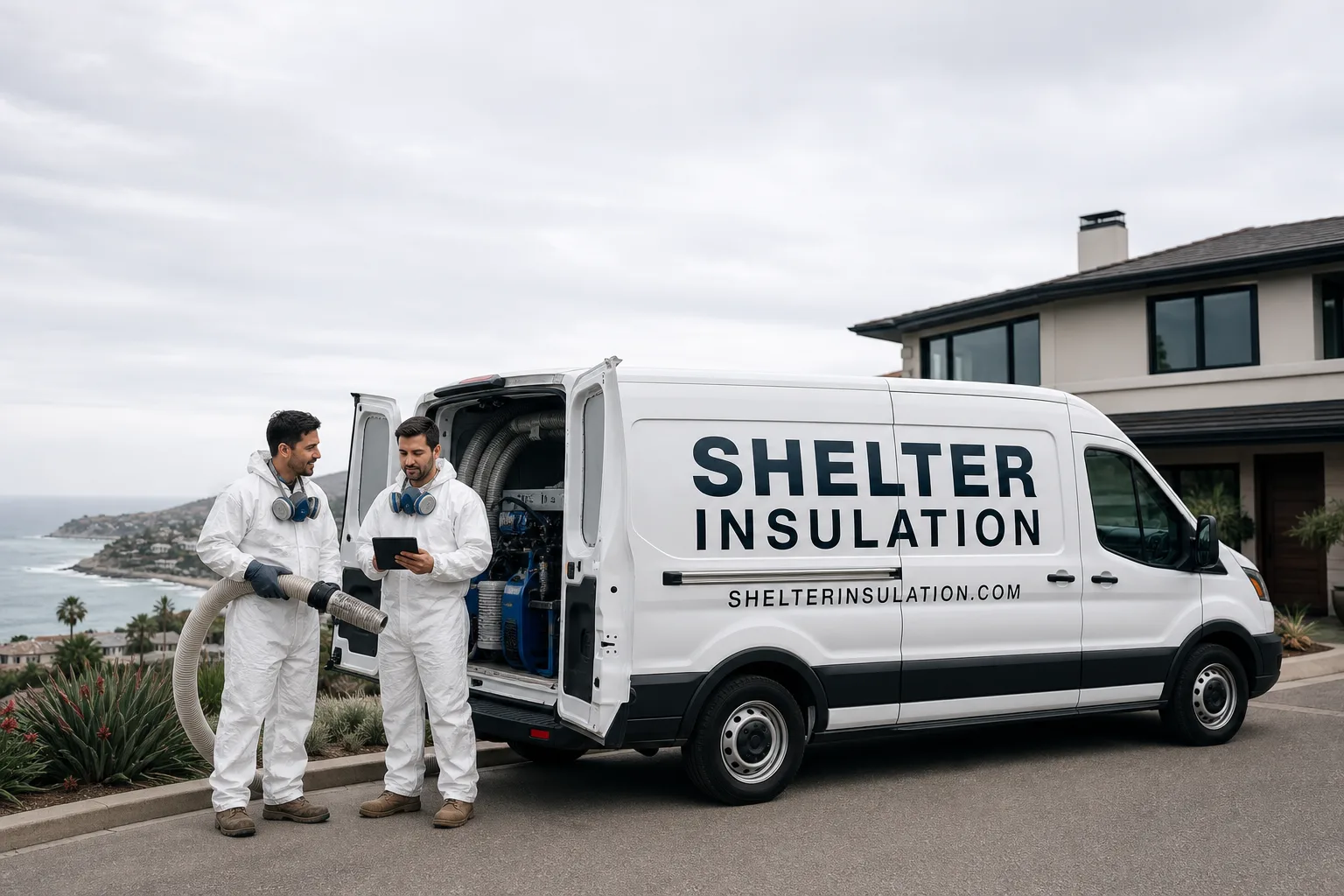
Attic Insulation in Ontario, CA: What It Costs and Why Older Homes Need More
Attic insulation in Ontario, CA typically runs $1,800 – $4,200 for a full upgrade on a standard 1,200 – 1,800 sq ft tract home, depending on what’s currently up there and whether you add a radiant barrier. Most homes built before 1980 in this city are sitting on original or badly degraded material that’s doing almost nothing against Inland Empire heat. If your upstairs rooms turn into ovens by 3 p.m. and your AC never cycles off from June through September, the attic is usually the culprit, not the unit itself.
We work throughout Ontario, from the older tracts south of the 10 to newer developments near the 15, and we’ve seen the same pattern in hundreds of attics: thin batts, settled loose-fill, and zero radiant protection. Call (855) 341-3373 for a free attic assessment, and we’ll tell you exactly what’s up there and what it would take to fix it.
Fast, Reliable Attic Insulation Across Ontario
Shelter Insulation serves every corner of Ontario, including the 91758, 91761, 91762, and 91764 ZIP codes, with a single crew that handles the full scope of Attic Insulation work. We’re in Ontario regularly, usually within a day or two of your call, because our Laguna Beach office keeps routes scheduled throughout the Inland Empire corridor. That means when you call us about a hot attic in late May, you’re not waiting three weeks for a crew that treats Ontario like an afterthought.
Our team knows the housing stock here. We know the low-pitch roofs on the 1960s tract homes near Euclid Avenue. We know the single-story stucco layouts that dominate neighborhoods around Ontario High School and the older grid streets south of Holt Boulevard. That local familiarity means we don’t show up and guess. We know what’s behind the access hatch before we open it.
Why Shelter Insulation Is Ontario’s Preferred Attic Insulation Company
Homeowners in Ontario call us because we don’t push one product. We carry eight manufacturer brands, including Owens Corning, Johns Manville, GreenFiber, and Demilec, so the conversation starts with what your house actually needs, not what we happen to have on the truck. That matters in a city where the housing stock ranges from original 1950s ranchers to 1990s two-story builds. The right material for a low-pitch 1962 tract home with a hot attic is not the same as the right material for a 1995 home with a standard vented attic.
Alan Brecker, who leads our team, set the company up around a simple principle: carry the full spectrum of insulation so we’re never forced to sell the wrong solution. That’s why our Ontario customers get options like blow-in cellulose from GreenFiber, closed-cell spray foam from Demilec, or mineral wool from Rockwool, all installed by the same crew. One contractor, one warranty conversation, one point of contact for the entire job.
We’ve done enough attics in Ontario to know what works here and what fails. When we recommend a radiant barrier on a south Ontario home with original 1960s loose-fill, it’s not an upsell. It’s the difference between an attic that stays under 120°F and one that hits 150°F by noon.
Attic Ventilation in Ontario
Attic Ventilation in Ontario is the difference between an insulation job that works and one that degrades fast in this climate. Homes here face a specific problem: daytime attic temperatures that routinely exceed 150°F for months on end, combined with original roof decks that were never vented properly by today’s standards. In a 1950s or 1960s tract home, that heat gets trapped, superheats your insulation, and forces your AC to fight a losing battle against the ceiling below.
Ventilation work on an Ontario home typically involves adding or replacing soffit vents, checking that baffles are clear at the eaves, and often installing ridge vents or gable vents to let heat escape. For older homes with low-pitch roofs, we frequently add attic baffles to keep blown-in insulation from blocking airflow at the soffits. Most ventilation upgrades in Ontario run $400 – $1,100 for typical tract home attic setups.
Why ventilation fails in older Ontario attics
The original vents on 1950s – 70s Ontario homes were often undersized, and after fifty-plus years they may be painted shut, blocked by bird nests, or filled with dust. When venting stops working, the attic becomes a heat reservoir. Insulation breaks down faster, roof decking warps, and your cooling bills climb every summer.
Venting plus insulation, not instead of it
Some Ontario homeowners assume ventilation alone will solve the heat problem. It won’t. Venting removes hot air, but it doesn’t stop heat from radiating down through a ceiling with R-4 settled loose-fill. You need both, and in a city where July afternoons hit triple digits routinely, the combination is what actually changes how your house feels.
Radiant Barrier in Ontario
Radiant Barrier in Ontario is one of the highest-impact upgrades you can add to an older tract home attic, because it directly addresses the city’s most punishing condition: intense, direct solar radiation. A radiant barrier is a reflective material installed on the underside of the roof rafters that reflects radiant heat back out instead of letting it transfer into the attic space. In Ontario’s summer, that can mean the difference between an attic that peaks at 125°F and one that hits 155°F.
Radiant barrier installation in Ontario typically costs $1,200 – $2,600 for a standard 1,200 – 1,800 sq ft attic, depending on whether it’s combined with new insulation or added to an existing attic. It’s most effective when paired with proper ventilation and a fresh insulation layer, which is why we usually quote it as part of a full attic upgrade rather than as a standalone.
How a radiant barrier changes the math
In a south Ontario home, the sun beats directly on the roof deck for six months a year. Without a barrier, that heat radiates down into the attic and through the ceiling. With one, much of it gets reflected before it ever reaches your insulation. Lower attic heat means lower ceiling surface temperatures, which means your AC doesn’t run as hard or as long.
When to add it on an Ontario tract home
If your attic already has adequate R-value insulation but your upstairs still bakes in summer, the missing piece is usually radiant heat. We see this constantly in Ontario homes where someone added fiberglass batts years ago but never addressed the roof deck. The insulation slows conduction, but it doesn’t stop radiation. A barrier is the fix.
Trusted Brands We Service in Ontario
We’re authorized to install products from Owens Corning, Johns Manville, GreenFiber, and Demilec, among our full eight-brand lineup, and we stock the materials Ontario homes need most. That includes Owens Corning fiberglass batts and loose-fill for open attics, GreenFiber cellulose for blown-in work in low-pitch attics where access is tight, and Demilec closed-cell foam for air-sealing and high-R-value applications in problematic roofs. We carry Demilec because closed-cell foam performs in extreme heat without losing R-value the way compressed fiberglass does after decades. We carry GreenFiber because blown-in cellulose reaches into the corners and odd cavities of older tract homes where batts simply can’t fit. When you call us for service in Ontario, the right material is available immediately, not something we need to special-order.
Common Attic Insulation Problems We See in Ontario Homes
- Settled 1960s loose-fill at R-4 or less: Original loose-fill insulation in south Ontario attics has compressed over sixty years of extreme temperature cycling. It’s often sitting at R-4 when current code recommends R-38 to R-49 for this climate zone.
- Compacted fiberglass batts in 1950s – 70s stucco homes: Batt insulation loses loft after decades of 150°F attic cycles, especially when foot traffic through the attic compressed it. A batt that started at R-19 can be performing at R-9 or less in an Ontario home.
- Missing or blocked venting under original roof decks: Many Ontario tract homes were built with minimal soffit venting, and after fifty years, those vents are often painted over or plugged. Trapped heat degrades insulation and pushes cooling costs up.
- No radiant barrier anywhere in the attic: The vast majority of older Ontario homes lack any radiant protection, which is why attic temperatures here routinely exceed 150°F even when there’s insulation present. The heat radiates straight through whatever insulation is there.
Pricing for Attic Insulation in Ontario, CA
Attic insulation pricing in Ontario runs from about $1,800 for a basic blown-in top-up on a smaller attic to $4,200 or more for a full removal, air-seal, new insulation, radiant barrier, and ventilation upgrade on a larger tract home. A standard blown-in cellulose or fiberglass job on a 1,200 – 1,500 sq ft attic typically lands between $2,200 and $3,400. Adding a radiant barrier usually adds $1,200 – $2,600. If your attic has original loose-fill that needs removal first, expect $600 – $1,200 for extraction and disposal, depending on attic height and access. No, topping off settled loose-fill without removing it rarely saves money in the long run. Six decades of dust, rodent debris, and compaction means old material keeps underperforming even with new insulation on top.
Call (855) 341-3373 for a free estimate. We’ll inspect the attic, measure what’s there, and give you an exact number before any work starts.
We Also Serve Cities Near Ontario
Beyond Attic Insulation in Ontario, our crews cover the surrounding Inland Empire communities, including Montclair, Chino, Los Serranos, and Jurupa Valley. If you’re in one of those areas and your attic is under-insulated or your summer cooling costs feel out of control, the same team that works in Ontario can handle your project. One call covers the whole region.
Serving Ontario, CA — Our Local Coverage Area
We’re based in the Ontario area and know this community well. Use the map below to see our service coverage — if you’re nearby, we can almost certainly help.
FAQs About Attic Insulation in Ontario
Technically yes, but we don’t recommend it. Original loose-fill in Ontario tract homes has settled and degraded to the point where it’s often performing at R-4 or less, and it’s usually contaminated with dust, rodent debris, and moisture from decades of roof cycles. Blowing new insulation on top traps that contamination and leaves the old material’s air leaks unaddressed. In the 91762 and 91764 ZIP codes specifically, where 1960s housing dominates, we almost always recommend removal and a fresh start. Call (855) 341-3373 and we’ll tell you what’s actually up there.
If your attic already has adequate insulation (roughly R-30 or higher) but your ceiling still feels warm to the touch in summer, the problem is radiant heat, not conduction. That’s the signal for a radiant barrier. In Ontario’s climate, we typically install both on older homes because most have neither adequate R-value nor radiant protection. An attic inspection settles the question in about twenty minutes.
Rooms that won’t hold temperature even with the AC running, ceilings that feel warm to the touch by mid-afternoon, inconsistent temperatures from room to room, and cooling bills that climb every summer. In Ontario specifically, if you live in an original 1950s – 70s tract home and you’ve never had the insulation checked, it’s almost certainly underperforming. Utility bills tell the story better than anything else.
Yes. Low-pitch attics have less headroom, which is exactly why blown-in insulation works so well in Ontario’s older tract homes. Blown-in reaches into tight corners and shallow cavities where fiberglass batts can’t be properly installed. We don’t need to modify your roof structure. We work through the existing attic access, and in most cases the entire job is done in a single day.
We install Owens Corning fiberglass, GreenFiber cellulose, and Demilec closed-cell spray foam, among others. For Ontario’s summer heat, we often specify Owens Corning loose-fill for open attics and Demilec closed-cell foam when air-sealing matters as much as R-value. The right call depends on your attic’s construction, not on what we have in stock. Call (855) 341-3373 for a free assessment.
Written by Alan Brecker, Owner at Shelter Insulation, serving Ontario and the Inland Empire with material-agnostic attic insulation solutions.