
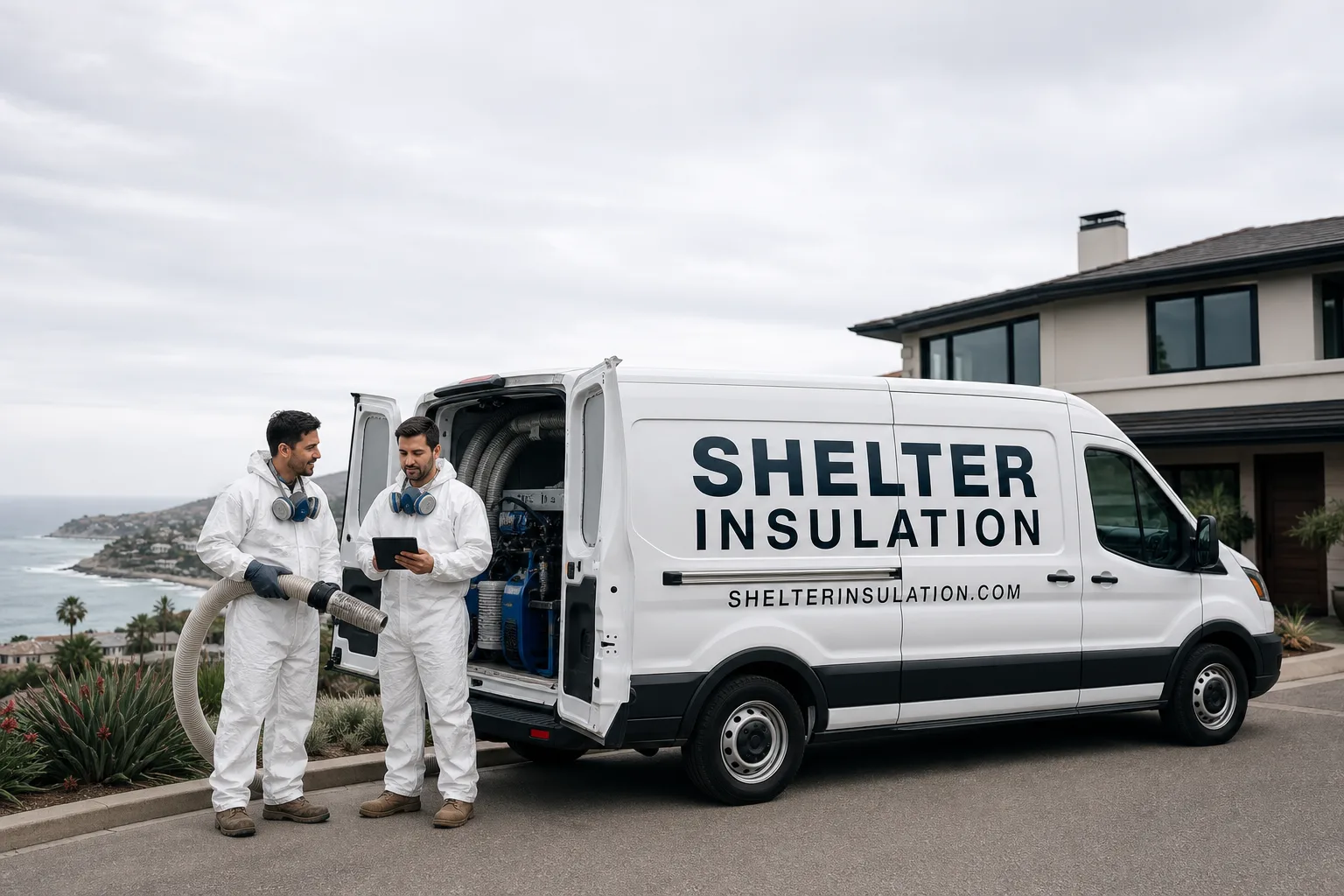
Fast, Reliable Attic Insulation Across Mission Viejo
Attic insulation in Mission Viejo usually runs $1.80 to $4.20 per square foot installed, with a typical 1,800-square-foot attic top-up landing between $950 and $2,300 depending on whether we’re blowing in new cellulose over settled batts or doing a full removal first. That’s the direct answer, and it matters because nearly every home in this city was built between 1968 and 1990, which means the original R-11 or R-13 batt insulation up there is now 35 to 55 years old and nowhere near what Saddleback Valley summers demand. We work in Mission Viejo every week, from the flat tracts around La Paz Road to the hillside clusters in 92692, and we know exactly what those attics look like before we even lift the access hatch. Call (855) 341-3373 and we’ll give you an honest read on what you actually need.
Key Takeaways
- Attic insulation upgrades in Mission Viejo never require HOA architectural review, no matter what your community’s design rules say about exterior changes.
- Most Mission Viejo homes still carry original 1970s-80s builder batts sized for R-11 to R-13, far below the R-38 to R-49 this climate needs.
- Typical Mission Viejo attic work costs $950 to $4,800 depending on scope: top-ups on the low end, full removal plus air-sealing on the high end.
- Heat rejection is the priority here, not cold-weather performance, because inland summer attic temps routinely exceed 140°F.
- One crew handles every insulation method, which means no coordinating three contractors for one attic.
Why Shelter Insulation Is Mission Viejo’s Preferred Attic Insulation Company
Our reputation in Mission Viejo is built on repeat work in the same tract communities, where one neighbor sees the truck and two more calls the same week. It’s a word-of-mouth city, and that suits how we work. We carry eight manufacturer lines – Owens Corning, Johns Manville, Knauf, Rockwool, CertainTeed, Icynene, Demilec, and GreenFiber – because no single material solves every attic in this town. A 1972 two-story off Marguerite Parkway with cathedral ceilings needs a different approach than a 1987 condo cluster in 92691 with shared wall cavities and tile-roof clearances. We don’t push one product; we match the material to the house.
Response time to Mission Viejo is typically 24 to 48 hours for an estimate, and we schedule most attic jobs within two weeks of approval. That matters in July, when a poorly insulated attic makes the upstairs bedroom feel like a sauna by 2 p.m. Our installers know the local building stock: stucco-on-wood-frame Spanish-style homes, tile roofs that trap heat, and tight attic clearances in the 92692 hillside tracts where radiant-barrier foil from old retrofits complicates every blown-in job. Alan Brecker built this company around the idea that a homeowner deserves straight answers about what’s actually in their attic, and our Mission Viejo customers keep telling us that’s exactly what they get.
Attic Mold Removal in Mission Viejo
Attic mold removal in Mission Viejo is a job we run into regularly because this inland valley’s warm days and cool coastal nights create condensation cycles inside under-ventilated attics, especially in the older single-story tracts where original soffit vents are now blocked by decades of paint or stucco overspray. When warm, moist air from the living space rises through ceiling penetrations and hits a cool roof underside at night, the resulting moisture feeds mold on the sheathing and rafters. A homeowner typically discovers this as a musty smell in the hallway, dark staining visible at the attic hatch, or a home inspector’s flag during a resale in a market where Mission Viejo home turnarounds are common.
What Removal Involves
The process means removing contaminated insulation, treating the affected framing and sheathing, correcting the ventilation deficiency that caused the problem, and installing new insulation once the space is dry and clean. In Mission Viejo’s 35-to-55-year-old attics, the mold is rarely visible from the living area, so we almost always find it during an insulation replacement when we pull back the old batts and see the telltale staining on the underside of the sheathing.
Mission Viejo Pricing
Attic mold removal in Mission Viejo typically runs $2,200 to $4,500 for a standard single-family attic, including insulation removal, treatment, ventilation upgrades, and new insulation. Smaller condo attic spaces in the 92691 and 92692 clusters often come in under $2,000. If you’ve noticed a smell or staining, call (855) 341-3373 and we’ll assess it honestly. Some discoloration is decades-old and inert; not every dark spot needs remediation, and we’ll tell you which is which.
Attic Insulation Removal in Mission Viejo
Attic insulation removal in Mission Viejo is almost always a retrofit necessity in this city because so many homes still hold the original fiberglass batts installed when the Mission Viejo Company built out the tract communities between the late 1960s and late 1980s. Those batts don’t just underperform now; in many cases they’ve compressed to half their original depth, absorbed dust and pest waste, or become saturated in spots from decades of minor roof leaks, and simply blowing new insulation over the top would seal those problems in rather than solve them. Removal is the right call when the old material is water-damaged, mold-contaminated, rodent-infested, or so degraded that air-sealing work underneath would be impossible.
When Top-Ups Aren’t Enough
If your existing insulation is dry, clean, and reasonably uncompressed, a top-up with blown-in GreenFiber or Johns Manville is often the more cost-effective route. But in the Madrid-style tracts off La Paz Road in 92692, our crew found original R-11 batts compressed to less than half their depth and missing entirely over the garage, letting attic temps spike past 140°F. We removed the deteriorated material, air-sealed the top plates, and blew in GreenFiber to R-49, then worked around existing radiant-barrier foil in the tight clearance sections. The homeowner reported the upstairs bonus room dropped several degrees on the first 95°F afternoon.
Removal Costs in Mission Viejo
Attic insulation removal in Mission Viejo typically costs $1.20 to $2.00 per square foot when done as a standalone job, so a 1,200-square-foot attic runs roughly $1,400 to $2,400 before new insulation goes in. When removal is paired with air-sealing and new blown-in installation, the full project usually lands between $3,000 and $5,500 for a typical two-story tract home.
Trusted Brands We Service in Mission Viejo
We install and service Attic Insulation materials from eight manufacturers, but for Mission Viejo’s specific heat-rejection needs we lean on a few workhorses. GreenFiber cellulose is our go-to for top-ups and removals in this city because it’s dense enough to slow the afternoon heat transfer that makes 92691 and 92692 upstairs rooms miserable in summer. We carry Demilec closed-cell foam for cathedral-ceiling sections and tight clearance areas where blown-in material can’t reach. And Owens Corning fiberglass, Johns Manville, Knauf, Rockwool, and CertainTeed each have specific jobs they solve: fire-resistant mineral wool for garage separation walls, fiberglass batts for standard bays, and high-density options for sound attenuation in attached condo clusters. We stock the materials Mission Viejo jobs actually use, which keeps turnaround short and means you’re never waiting on a special order when the heat is already here.
Common Attic Insulation Problems We See in Mission Viejo Homes
- Compressed or sagging 1970s-80s builder batts. In two-story Mediterranean-style tracts across 92690 and 92692, the original R-11 to R-13 fiberglass has settled, compressed, or fallen away at the eave edges, leaving the attic floor effectively uninsulated in strips. The upstairs rooms directly below those gaps bake in summer while adjacent areas stay merely warm.
- Missing insulation over garage and cathedral-ceiling sections. Mission Viejo Company-built homes frequently skipped or under-insulated the attic space above the garage and the framed cathedral sections, which means a big chunk of your conditioned envelope leaks heat straight into the attic. We find this in nearly every replacement we do in this city.
- Radiant-barrier foil from prior retrofits that traps heat or gets torn. Hillside homes in 92692, especially the Spanish-style tile-roof clusters, often received radiant barrier in the 1990s or 2000s. If installed on the attic floor rather than the roof deck, it collects dust, loses reflectivity, and becomes a hazard to work around during blown-in installation. If installed at the roof deck, it can create a ventilation dead zone if intake air is blocked.
- Blocked soffit vents from decades of paint, stucco overspray, and tile roof work. The original continuous soffit venting on Mission Viejo’s stucco-on-wood-frame homes gets choked by painting and patching over the years, cutting intake airflow to near zero. Without airflow, the attic becomes a hot box, and that’s when you get mold on the north-facing sheathing and paint blistering on the south-facing eaves.
Pricing for Attic Insulation in Mission Viejo, CA
Here’s what we’re actually charging for attic work in Mission Viejo right now. A basic blown-in top-up over clean, existing insulation runs $0.80 to $1.20 per square foot, so a 1,500-square-foot attic lands around $1,200 to $1,800. Full removal plus new blown-in GreenFiber or Owens Corning loose-fill to R-49 runs $2.80 to $4.20 per square foot, or roughly $4,200 to $6,300 for that same 1,500-square-foot attic when we include air-sealing of top plates, can-light covers, and hatch weatherstripping. Batt installation for accessible flat attics falls between $1.10 and $1.80 per square foot, less common here because blown-in typically covers better around the framing. Spray foam – usually Demilec closed-cell for cathedral sections or garage lids – runs $4.50 to $7.00 per board foot. Every Mission Viejo quote is free, in writing, and itemized, and it holds for 30 days because prices shouldn’t move between the estimate and the work. Call (855) 341-3373 for a number that reflects your attic, not a regional average.
We Also Serve Cities Near Mission Viejo
Our crews cover the full Saddleback Valley, so if you’re in Coto De Caza, Lake Forest, Laguna Hills, or Rancho Santa Margarita, the same crew and the same eight-brand material options are available to you. Many of our Mission Viejo customers actually find us while comparing contractors across the valley. If you want to see how we handle a specific neighborhood, Attic Insulation in Mission Viejo gives you the full local picture, and we’re already running jobs in every one of those nearby cities most weeks.
Serving Mission Viejo, CA — Our Local Coverage Area
We’re based in the Mission Viejo area and know this community well. Use the map below to see our service coverage — if you’re nearby, we can almost certainly help.
FAQs About Attic Insulation in Mission Viejo
No, you don’t need HOA or architectural-review approval for attic insulation work in Mission Viejo. The city’s design-review rules, whether through the Mission Viejo Company-era master HOA or your specific tract association, only govern visible exterior modifications: paint colors, rooflines, window styles, landscaping. Attic insulation happens entirely inside the envelope and never appears on any elevation drawing, so it’s outside design-review purview entirely. This surprises a lot of homeowners in the 92692 hillside clusters who’ve been through approval processes for fence replacements and expect the same for any home project. You can schedule attic work without contacting your HOA at all, and the work won’t trigger any violation notices because nothing visible changes. If you’d like, we’ll still document the scope in writing so you have it for your records, but there’s no approval to wait on. Call (855) 341-3373 and we can start sooner than you probably expected.
In most 92691 condo and townhome clusters we service, the original batts can be topped up rather than removed, provided they’re dry, free of pest contamination, and not compressed past usefulness. The call comes down to condition, not age alone. If the batts are still holding some loft and there’s no water staining or rodent activity, blowing GreenFiber or Owens Corning loose-fill directly over them to reach R-38 or R-49 is the most cost-effective fix and is exactly what we recommend for most of these units. If the existing material is matted, dusty from decades of air leakage, or shows signs of roof leaks at the plumbing penetrations, removal is the better route because the air-sealing work underneath matters more than the insulation on top. We’ll inspect the attic and tell you which path your unit actually needs, with photos so you can see the condition yourself before deciding.
For tight-clearance attics in the 92692 hillside tracts, we adjust the method to the space rather than forcing a standard approach. Where roof pitch or knee walls leave less than 30 inches of working height, we use a combination of dense-pack GreenFiber for the low sections, Demilec closed-cell spray foam for cathedral-ceiling portions where no vented attic cavity exists, and careful hand-work around existing radiant-barrier foil rather than ripping it out. The radiant barrier actually helps in these homes when it’s on the roof deck and undisturbed, so we work around it intentionally instead of treating it as an obstacle to remove. This is a skill set that comes from doing repeated jobs in the same Mission Viejo tracts, not from a generic insulation crew running one method across a whole region.
Attic insulation work never touches your tile roof, exterior stucco, or any visible surface. Everything happens from the attic access hatch, which in Mission Viejo homes is almost always a small ceiling panel inside a closet, hallway, or garage. The work is interior-only, which is also why it bypasses HOA design review. Tile roofs stay intact, stucco walls stay untouched, and the only exterior trace of the job is our truck in the driveway for a few hours. For 92692 homes with radiant-barrier foil already attached to the roof deck, we take care to work around the foil and preserve whatever reflectivity remains, because damaging an existing retrofit would only make the attic hotter.
For Mission Viejo’s inland Saddleback Valley climate, where summer afternoons regularly push into the 90s and occasionally past 100°F while attics exceed 140°F, we recommend R-38 as the minimum for vented flat attics and R-49 wherever the attic depth allows it. That’s notably higher than the coastal standard of R-30 that nearby beach cities use, and it reflects the heat-rejection priority of this valley location. Blown-in cellulose or fiberglass at R-49 typically means 14 to 16 inches of settled material, which most Mission Viejo attics can accommodate without issue. Cold-weather R-value matters less here; what you’re buying is resistance to attic heat radiating down through the ceiling into your living space. Air-sealing matters just as much in this climate because the stack effect that pulls conditioned air up through every crack is most aggressive when the attic is hottest, so we seal top plates and penetrations on every job. Call (855) 341-3373 and we’ll measure your specific attic depth and give you the exact R-value number that fits, along with the material option that gets you there cleanly.
If your Mission Viejo attic is still running on original 1970s or 1980s insulation, you’re paying for it every single summer afternoon whether you notice it or not. We’ll come out, look at what’s actually up there, and give you a straight answer with real numbers. Call (855) 341-3373 for a free estimate.
Written by Alan Brecker, Owner at Shelter Insulation, serving Mission Viejo and the Saddleback Valley since our founding.