
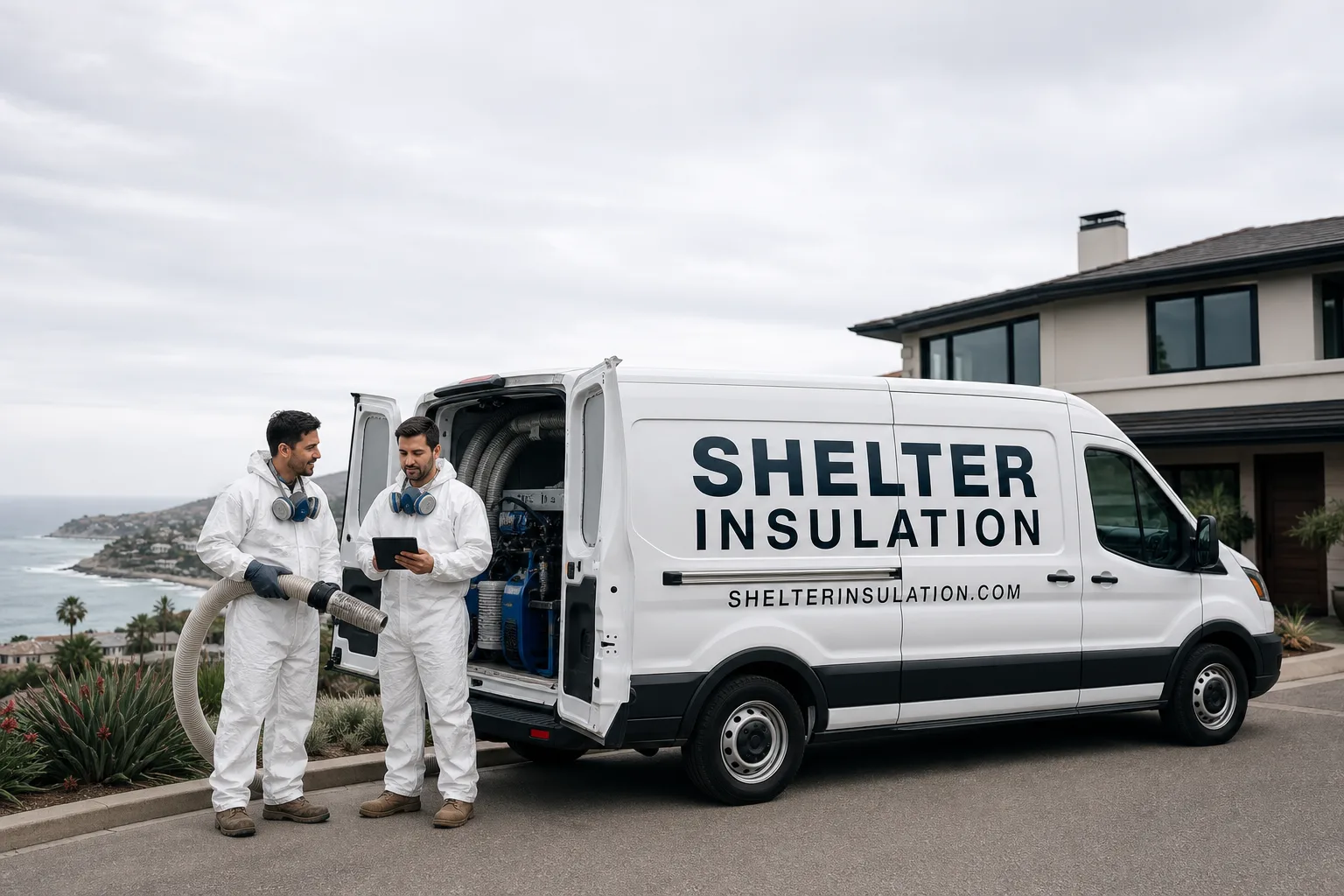
Fast, Reliable Attic Insulation Across Portola Hills
Attic insulation in Portola Hills usually costs between $1,800 and $4,600 depending on attic size, access, and material choice, with blown-in or batt top-ups on the lower end and full removal plus air sealing on the higher end. We work throughout the 92610 zip code, and our crews know the tract layouts off Saddleback Ranch Road, Glenn Ranch Road, and Ridgeline as well as any local tech. If your attic still has builder-grade R-11 or R-19 batts from the 1980s or 1990s, you’re losing conditioned air every single day. Call (855) 341-3373 for a free estimate, and we’ll tell you exactly what’s going on up there before you spend a dollar.
Key Takeaways
- Portola Hills attics face a two-sided problem: heavy afternoon solar gain plus damp marine-layer mornings that cycle daily.
- Stepped and sloped rafter bays make standard blanket insulation a poor fit in many hillside tract homes.
- Builder-grade R-11 batts in 1980s and 1990s homes are usually compressed, sagging, or missing entirely over top plates.
- We carry fiberglass, mineral wool, cellulose, and spray foam, so the material matches the attic, not a sales pitch.
Why Shelter Insulation Is Portola Hills’s Preferred Attic Insulation Company
Portola Hills isn’t a flat-lot suburb. The graded hillside terrain means attics here are sloped, stepped, and irregular in ways that a cookie-cutter insulation bid doesn’t account for. Our crew has been through enough of these attics that we check the knee walls and cantilevered cavities above garages first, because those are where the builder skipped insulation and where the heat and cold actually move.
Alan Brecker runs our projects with one simple rule: quote the right material for the specific attic, not whatever’s leftover on the truck. That’s why we’re authorized to install products from eight manufacturers, including Johns Manville, Owens Corning, GreenFiber, and Knauf. When a Portola Hills homeowner asks whether they need blown-in cellulose or batts or spray foam, we can actually answer based on their attic, not our inventory.
Single-contractor accountability matters here more than most places. A stepped attic with knee walls, a cantilevered floor cavity, and a low-clearance section above the living space often needs three different installation methods on the same job. We handle blown-in, batt, and spray foam with one crew, one warranty conversation, and one point of contact. That’s the practical difference between a project that’s done right and one that’s coordinated into frustration.
Attic Mold Removal in Portola Hills
Attic mold removal in Portola Hills addresses a problem that the local climate manufactures on its own. The Santa Ana Mountains foothills pull a marine layer in most mornings, then bake it off by early afternoon. That daily humidity swing means any attic with weak ventilation or unsealed penetrations becomes a condensation chamber, and mold follows. In the 1980s and 1990s tract homes that dominate this community, the original soffit vents and baffles were often undersized for the sloped roof geometry, which makes the problem worse.
When we remove attic mold in Portola Hills, we don’t spray and walk away. The job involves identifying the moisture source first, replacing compromised baffles, cleaning or replacing the affected insulation, and treating the framing so the mold doesn’t come back. We’ll also verify that bath fans actually exhaust to the exterior and not into the attic, a common defect in era-appropriate construction throughout the 92610 area.
Marine-Layer Condensation Damage
Morning marine layer pushes moisture through unsealed top plates and into the attic cavity, where it condenses against the underside of the roof deck. Once that cycle repeats for a few seasons, sheathing stains, framing begins to hold moisture, and mold spores find a foothold. The fix is always the same order of operations: air seal, vent, remove, replace, treat. Skipping any step means the problem returns in a single season.
Stepped Attic & Knee Wall Mold
Stepped attics above garages and bedrooms trap humid air in dead pockets that standard ventilation doesn’t reach. We open these sections carefully because they’re often where the worst mold is hiding, behind knee walls and below the roofline step. Our team removes the affected insulation, treats the framing, and installs baffles that actually maintain airflow in those irregular cavities.
Attic Insulation Removal in Portola Hills
Attic insulation removal in Portola Hills is not a luxury upgrade. It’s the necessary first step for hundreds of homes in this community that still have the original builder-installed batts from the Reagan and Clinton eras. R-11 fiberglass in a 1990s tract attic is already underperforming, and in a hillside home with sloped rafter bays and stepped geometry, those batts have almost certainly compressed, sagged, or shifted away from the roof deck.
We remove old insulation here for three main reasons: contamination from rodent activity or mold, compression that’s killed the effective R-value, or a homeowner who’s ready to switch to a better material for the climate. The removal process in a Portola Hills attic typically runs $800 to $1,800 depending on square footage, access difficulty, and whether disposal of contaminated material is required. It’s physical, dusty work in tight spaces, and it’s the kind of job where an experience difference shows up immediately.
Rodent and Contamination Cleanup
Attics above hillside lots attract rodents from the surrounding open space and canyon edges, and the droppings and nesting material they leave behind compromise insulation permanently. We remove the contaminated batts, sanitize the area, air seal the entry points, and install fresh material. Skipping the removal and just blowing new insulation on top doesn’t fix anything; it preserves the contamination underneath.
Compression and R-Value Loss
When batts are pressed into a rafter bay that’s too shallow, or when they’ve been walked on during cable runs and repairs, the trapped air pockets that give insulation its thermal performance collapse. We see this constantly in Portola Hills attics where the original R-11 was never right for the space to begin with. Removal and proper reinstallation at full loft restores the rated R-value and stops the convective heat loss that makes rooms over the garage feel ten degrees off.
Trusted Brands We Service in Portola Hills
We stock and install the materials that match Portola Hills attics, not the materials that are cheapest to ship. Johns Manville batts custom-cut to irregular rafter bays, Owens Corning blow-in for low-clearance sloped sections, GreenFiber cellulose for dense-pack knee walls, and Knauf mineral wool where fire resistance and acoustics matter. Because we’re authorized across eight manufacturers, a Portola Hills homeowner gets the right product for the cavity, the climate, and the budget, without the upsell pressure that comes from a contractor who only carries one or two lines. Turnaround on local projects is usually within the week, and we’re not ordering from out of state. Parts and materials for 92610 attics are in our local inventory.
Common Attic Insulation Problems We See in Portola Hills Homes
- Compressed original batts in sloped rafter bays: The 1980s and 1990s tract homes in Portola Hills were built fast, and the original R-11 and R-19 batts were often crammed into bays that were never sized for them. In hillside attics, that compression is worse because the roof pitch changes, and the batts slide and bunch.
- Unsealed top plates leaking conditioned air: We find unsealed top plates in nearly every original-insulation attic we open in this area. It’s the single biggest air leak in Portola Hills homes, and it’s also the path that lets marine-layer moisture into the attic all morning, every morning.
- Uninsulated knee walls and cantilevered floor cavities: Where a Portola Hills home steps down or sits above a garage, the builder usually skipped insulation entirely. The wall between the attic and the living space is just drywall and air, and the floor over the garage is the same. These two cavities are responsible for most of the “my bedroom is freezing at night and boiling by 3pm” complaints we hear.
- Rodent traffic from canyon edges and open space: The hillside lots that define Portola Hills sit adjacent to canyons and preserved open space. That means roof rats and mice find their way into attics through roof vents and eave gaps, and once they’re in, insulation becomes nesting material. We see more rodent contamination in 92610 attics than in the flat-lot cities just west of here.
Pricing for Attic Insulation in Portola Hills, CA
Here’s what we quote in the Portola Hills market. A simple blown-in top-up over existing insulation runs $1,800 to $2,800 for a typical 1,500-square-foot attic. Full removal of old batts, air sealing, and new blown-in or batt installation runs $3,200 to $4,600. Attic baffle replacement and ventilation prep adds $400 to $900 depending on how many bays need work. If your attic has knee walls or a cantilevered floor cavity that need to be insulated, add $600 to $1,200 per cavity. These are real numbers for 92610 homes, not generic statewide averages. Call (855) 341-3373 and we’ll walk the attic with you before we quote, so you know exactly what the number covers.
We Also Serve Cities Near Portola Hills
Our crews work throughout the Saddleback Valley. If you’re in Foothill Ranch, Lake Forest, Mission Viejo, or Trabuco Canyon, we handle the same attic insulation, removal, and mold issues with the same crew and the same eight-brand product line. This page focuses on Attic Insulation in Portola Hills, and we also maintain a full Attic Insulation overview for all of Orange County.
Serving Portola Hills, CA — Our Local Coverage Area
We’re based in the Portola Hills area and know this community well. Use the map below to see our service coverage — if you’re nearby, we can almost certainly help.
FAQs About Attic Insulation in Portola Hills
Portola Hills sits in the foothills where the marine layer rolls in every morning and burns off by early afternoon. That daily humidity cycle sends damp, salt-laden air through unsealed top plates and into attic cavities over garages. When the moisture settles on garage-door springs, hinges, and roller tracks, corrosion starts years before it would in a drier inland attic. Our recommendation is to air seal the attic first and then inspect the hardware, because the insulation fix and the corrosion fix are actually the same fix.
No, not by itself. Standard blown-in insulation works well in open, flat attic floors, but a stepped attic with sloped rafter bays and knee walls needs custom-cut batts plus dense-pack where the ceiling steps down. The gap where the roofline changes height is exactly where heat and cold air move, and blown-in alone won’t stay in those vertical and sloped sections. We address stepped attics with a combination of custom-fit batts, dense-pack cellulose for the knee wall cavities, and air sealing at every transition. Call (855) 341-3373 and we’ll check your specific attic geometry.
Check the attic access panel and any knee wall doors first, since those are the easiest to see without climbing in. Then look at the insulation over your top plates, which in a 1990s tract home is usually either missing or shifted. The overnight draft in Portola Hills homes is almost always air leakage through unsealed penetrations, not a lack of bulk insulation. When the sun goes down and the canyon air cools, the warm air inside your home rises through those leaks and pulls cool outside air in through the walls and floor. We find this in nearly every original-insulation home we inspect in the 92610 area.
It does, but indirectly. Salt-air corrosion attacks exposed metal, so the garage-door springs, hinges, and fasteners in an unsealed attic will corrode faster here than in Lake Forest or Mission Viejo. The insulation side of the problem is that the same unsealed top plates that let moisture reach the hardware are also leaking conditioned air. We choose insulation materials that don’t absorb water, like closed-cell foam or mineral wool in the moisture-prone sections, and we always recommend air sealing before any hardware replacement so the corrosion problem doesn’t just come back.
Every three to five years if we installed the insulation, and sooner if you still have the original R-11 batts. The daily marine-layer cycle in Portola Hills means original insulation degrades faster than in drier inland cities, and the sloped, stepped geometry hides problems until they’re expensive. We inspect for compression, moisture intrusion, rodent activity, and hardware corrosion in one visit. The inspection is free, and you’ll know where you stand before anything fails.
Ready to fix the attic that’s been costing you sleep and utility dollars? Call (855) 341-3373 for a free estimate. Alan Brecker and the Shelter Insulation crew will walk your Portola Hills attic, tell you exactly what’s going on, and quote the right material for the job. No pressure, no upsell, just a clear answer and a fair number.
Written by Alan Brecker, Owner at Shelter Insulation, serving Portola Hills and the Saddleback Valley.